The hidden costs of using Excel for trading operations go far beyond the occasional formula error. For dairy ingredient traders, Excel quietly drains time, creates data gaps, and introduces operational risk that only becomes visible when something goes wrong. The questions below unpack exactly where those costs accumulate and what a more connected approach looks like.
How does Excel actually slow down trading operations?
Excel slows down trading operations by breaking the connection between your data and your decisions. Every time a price changes, a contract is updated, or a shipment moves, someone has to manually find the right file, enter the update, and hope every other version gets corrected too. That lag between reality and record is where trading operations lose speed and accuracy.
In dairy ingredient trading specifically, the pace of operations does not match what a spreadsheet was designed to handle. Contracts are live documents. Positions shift throughout the day. Logistics depend on accurate stock figures. When all of that information lives in separate files maintained by different people, the system slows to the pace of whoever last saved their version.
The deeper issue is that Excel is a static tool in a dynamic environment. It captures a moment in time, not a continuous flow of activity. Traders end up spending significant parts of their day not on trading decisions, but on data maintenance tasks that a connected system would handle automatically. That is time that does not show up as a cost on any invoice, but it accumulates every single working day.
What are the most common Excel errors in commodity trading?
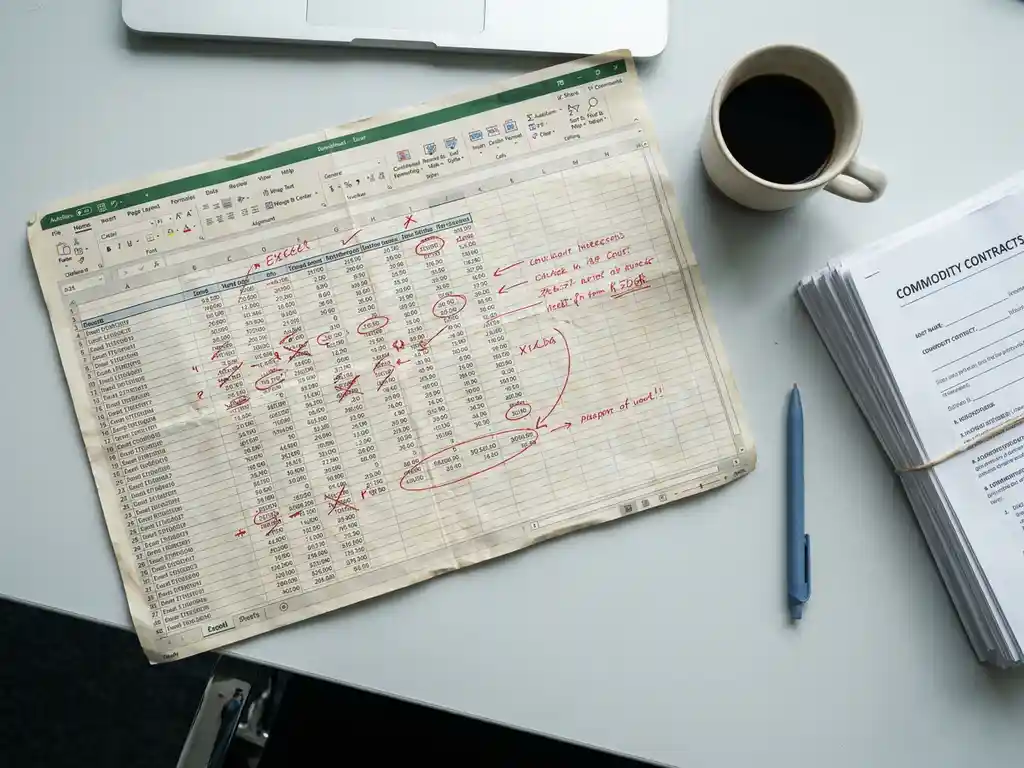
The most common Excel errors in commodity trading are formula reference mistakes, version conflicts, and manual entry errors. A single copied formula that references the wrong row can silently distort margin calculations, position totals, or invoice amounts for days before anyone notices. In fast-moving commodity markets, that kind of invisible error carries real financial consequences.
Version conflicts are equally damaging. When two traders update separate copies of the same file and one overwrites the other, or when no one is sure which version is current, the result is not just confusion. It is decisions made on data that no longer reflects reality.
Manual entry errors are the most frequent and the hardest to catch. Transposing two digits in a quantity, entering a price in the wrong currency column, or duplicating a line item are all mistakes that happen under time pressure. Unlike a structured system with validation rules, Excel accepts whatever you type without question. The error only surfaces when the numbers stop making sense, and by then the damage may already be done.
How much time does manual data entry in Excel actually cost?
Manual data entry in Excel costs dairy ingredient traders a meaningful portion of every working day, though the exact amount depends on the size and complexity of the operation. What makes this cost easy to underestimate is that it does not happen in one block. It is spread across dozens of small tasks: copying contract details into an order file, updating a position sheet, reconciling a logistics update, preparing an invoice summary. Each task feels quick. Together, they consume hours.
Beyond the time spent entering data, there is also the time spent checking it. Because errors are common in manually maintained spreadsheets, experienced traders develop habits of double-checking figures before acting on them. That verification step is itself a cost, and it reflects a fundamental lack of trust in the data. A system that updates automatically and validates entries at the point of input eliminates both the entry time and the checking time.
For a small team of two to five people managing active contracts across multiple counterparties, the cumulative time lost to manual data work each week can easily represent the equivalent of one full working day. That is time that could go toward sourcing, customer relationships, or simply managing the business with less stress.
What happens when your trading team outgrows Excel?
When a trading team outgrows Excel, operations become fragile. The signs are recognizable: more staff means more versions of the same file, more risk of conflicting updates, and less clarity about who owns which data. What worked for one person managing a handful of contracts starts to break under the weight of a growing team and a growing book of business.
The fragility shows up in specific ways. A new team member updates a file without knowing there is a newer version in someone else’s inbox. A contract detail gets missed because it was entered in one sheet but not carried across to the logistics tracker. A customer asks for an update and no one can give a confident answer without first checking three different files.
Growth also changes the nature of the oversight problem. A sole trader using Excel has all the context in their head and can compensate for gaps in the data. A team cannot share that mental model. Without a single connected system, the team compensates through more meetings, more emails, and more manual reconciliation. The overhead grows faster than the business does, and that is when the real cost of outgrowing Excel becomes impossible to ignore.
This is also the point where the risk of a serious operational failure increases. A missed delivery, a contract dispute, or a billing error that stems from a data gap is not just an inconvenience. For a business built on trust with suppliers and customers, it is a reputational issue.
Is there a better alternative to Excel for dairy ingredient traders?
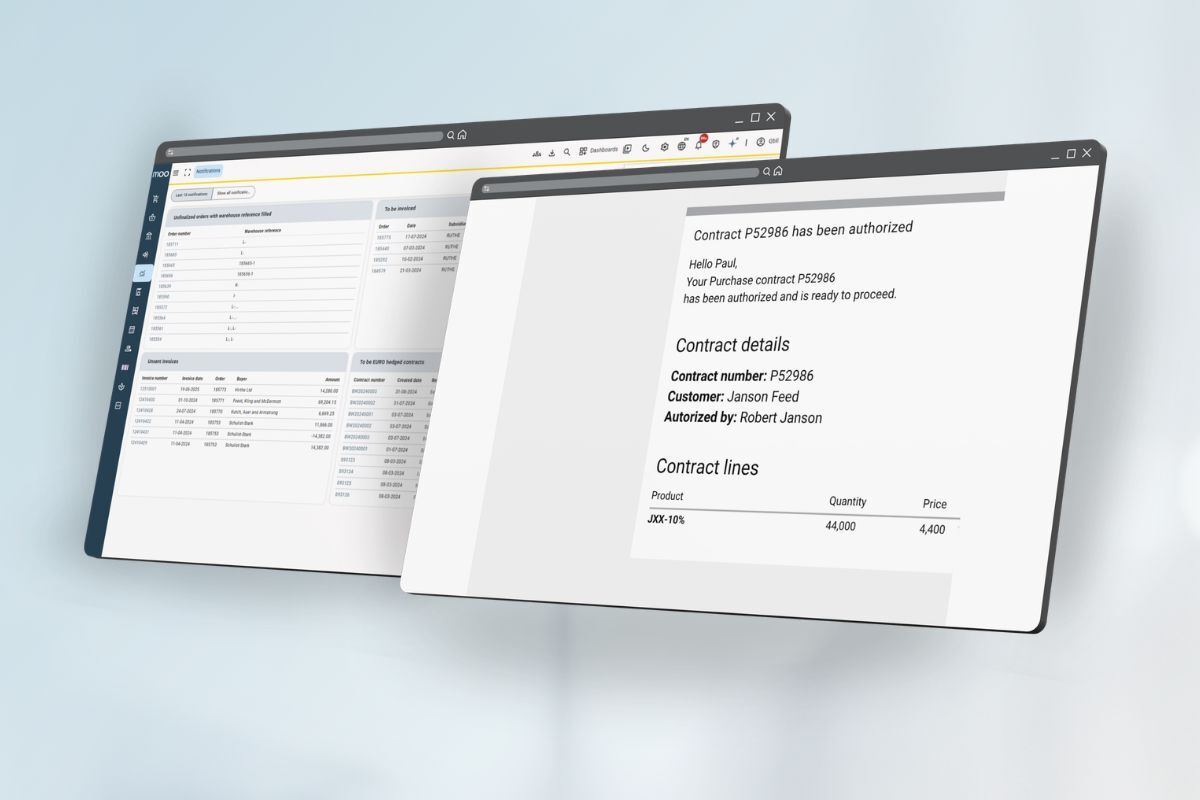
Yes, and it is purpose-built software designed specifically for the way dairy ingredient trading actually works. The right alternative is not a generic ERP system adapted with workarounds. It is a system that understands contracts, positions, logistics, and invoicing as connected activities rather than separate spreadsheets. For traders in milk powder, whey, butter, cheese, and plant-based ingredients, that specificity matters.
A dedicated trading platform gives every team member a live view of the same data. Contracts update positions automatically. Orders connect to logistics. Invoicing draws from confirmed data rather than manually compiled summaries. The result is not just fewer errors. It is faster decisions, clearer oversight, and less time spent on administration.
Construimos Software Moo specifically for this situation. It is designed for dairy ingredient and commodity traders who want to move beyond spreadsheets without the complexity and cost of a large enterprise system. The onboarding is straightforward, and your environment is fully operational within two days, so the transition does not require a lengthy implementation project.
If you are at the point where Excel is creating more work than it saves, that is a reliable signal that the operation has grown beyond what a manual system can support. The question is not whether a better alternative exists. The question is how much longer the current approach is worth the cost. If you want to explore what that looks like for your business, contáctanos and we can walk you through it.
Preguntas frecuentes
How do I know if my dairy trading operation is ready to move away from Excel?
The clearest signs are operational, not financial: if your team regularly debates which file version is current, if onboarding a new trader means teaching them your spreadsheet system rather than your business, or if you have ever made a decision based on data that later turned out to be outdated, you have already outgrown Excel. You do not need to be a large operation to justify purpose-built software — even a small team managing active contracts across multiple counterparties will see an immediate return in time saved and errors avoided.
What are the biggest risks of staying on Excel as our contract volume grows?
The risk profile changes significantly as volume increases: more contracts mean more manual touchpoints, and each one is an opportunity for a formula error, a missed update, or a version conflict to introduce a costly mistake. In dairy ingredient trading, where margins can be tight and relationships with suppliers and customers depend on reliability, a billing error or missed delivery tied back to a data gap is not just a financial problem — it is a trust problem. The risk does not scale linearly with volume; it compounds, because errors in one sheet often cascade into others.
Can a purpose-built trading platform integrate with the other tools we already use, like accounting software?
Most modern commodity trading platforms are designed with integration in mind, allowing data to flow between your trading system and accounting, ERP, or logistics tools without manual re-entry. The key question to ask any vendor is whether the integration is native and maintained, or whether it relies on manual exports and imports that recreate the same data-gap problem you are trying to solve. A well-integrated system means your invoicing, position reporting, and financial records stay aligned automatically rather than requiring a reconciliation step at month end.
How long does it typically take to migrate existing contract and position data from Excel into a new system?
Migration timelines vary depending on the volume and structure of your existing data, but for most small-to-mid-sized dairy ingredient trading operations, a focused migration effort can be completed in a matter of days rather than weeks — especially when the new platform is purpose-built and the onboarding process is structured. The practical advice is to use a migration as an opportunity to clean your data: standardise counterparty names, resolve duplicate entries, and confirm open contract positions before importing, so you start on the new system with a clean, trusted dataset.
What should we do to prepare our team for the transition away from Excel?
The most important preparation is not technical — it is cultural. Teams that have used Excel for years have often built informal workarounds and personal filing habits that will need to change. Involving key users early in the evaluation process, clearly communicating why the switch is happening, and running a short parallel period where both systems are active can reduce resistance and catch any gaps before you fully cut over. Choosing a platform with a short onboarding curve also matters: the less time your team spends learning the tool, the faster they can focus on using it.
Are there specific Excel practices that are higher risk than others in commodity trading?
Yes — the highest-risk practices are those where Excel is being used as a live, multi-user document rather than a personal calculation tool. Shared files edited by multiple people, workbooks that link to other workbooks across a network drive, and sheets where a single formula error can propagate across position or margin calculations are all particularly dangerous. If your operation relies on any of these, a silent error can go undetected for days. Treating Excel as a read-only reporting tool rather than a system of record is a meaningful risk reduction step while you evaluate longer-term alternatives.
Is purpose-built trading software cost-effective for smaller dairy ingredient trading businesses?
For smaller operations, the cost calculation often surprises people: when you account for the hours spent on manual data entry, error checking, and reconciliation each week, the true cost of staying on Excel frequently exceeds the subscription cost of a dedicated platform. Purpose-built tools designed for commodity traders — rather than large enterprise ERP systems — are typically priced to be accessible for small and growing teams, with onboarding that does not require a lengthy or expensive implementation project. The relevant question is not whether you can afford to switch, but whether you can afford the ongoing overhead of not switching.