
Dairy traders still rely on spreadsheets in 2026 because the tools feel familiar, free, and flexible enough to handle the job — until the job grows beyond what a static file can manage. Spreadsheets were never designed for real-time, multi-person trading operations, but they became the default long before purpose-built alternatives existed for niche industries like dairy ingredient trading. The questions below unpack exactly why that habit persists, where it breaks down, and what a better setup actually looks like.
What makes spreadsheets so hard to give up in dairy trading?
Spreadsheets are hard to give up in dairy trading because they worked at first. When a business handles a handful of contracts, one buyer, and a small logistics chain, a well-organized Excel file genuinely covers the basics. The tool is already installed, everyone knows how to use it, and there is no upfront cost or learning curve. That early success creates a strong anchor.
Over time, the spreadsheet grows with the business. A new tab is added for a second supplier. Another for tracking milk powder positions. A separate file for butter contracts. A shared drive folder starts filling up with versions named “final,” “final_v2,” and “final_ACTUAL.” At no single point does anyone decide to build a fragile system. It just accumulates, one logical workaround at a time.
The deeper reason this habit sticks is psychological. When Excel is all you have ever seen used in your corner of the industry, it stops looking like a workaround and starts looking like the standard. The assumption becomes: this is just how dairy trading works. That assumption is the hardest thing to challenge, because it means the problem never gets named. You cannot search for a solution to a problem you do not know you have.
There is also a real switching cost to consider. The spreadsheets already exist. The data is in there, somewhere. Starting fresh with new software feels like extra work on top of an already demanding operation. So the files stay, the workarounds multiply, and the system holds together — right up until it does not.
What goes wrong when dairy traders rely on spreadsheets?
When dairy traders rely on spreadsheets, the most common failures are silent ones: a copied formula that carries an error forward for weeks, a contract detail entered in one file but not updated in another, or a position that looks balanced on screen but does not reflect a last-minute order change. These are not dramatic crashes. They are quiet distortions that only surface when something downstream goes wrong.
In dairy ingredient trading, the stakes of these errors are real. A misread contract quantity can affect a logistics booking. A missed pricing update can compress a margin before anyone notices. A delivery window entered incorrectly in one file but correctly in another means two people in the same business are working from different realities.
The problem with manual data entry
Every time information moves from an email to a spreadsheet, or from a spreadsheet to an invoice, a human has to retype it. Each retyping is a chance for error. In a busy trading operation, that process happens dozens of times a day across contracts, orders, logistics updates, and financial records. The cumulative risk is not dramatic, but it is constant.
The problem with version control
When multiple people work on the same trading data, spreadsheets do not update in real time for everyone. One person saves a file. Another opens an older version. A third emails a copy to a logistics partner. By the end of the day, there are three versions of the same contract data in circulation, and no reliable way to know which one is current. In a business where a delayed decision is often a missed opportunity, that lag matters.
How do spreadsheets fail when a dairy trading team grows?
Spreadsheets fail in growing dairy trading teams because they are built for individual use, not collaborative operations. A single person maintaining a single file can keep it accurate. Add a second person, a third supplier, a fourth market, and the file becomes a coordination problem rather than a management tool. The more people touching the same data, the faster trust in that data erodes.
Growth also brings complexity that spreadsheets simply cannot model well. A small trader handling a few contracts per month can track positions manually. A team managing dozens of active contracts across multiple product lines, currencies, and delivery windows needs a system that connects those moving parts automatically. Spreadsheets require someone to make those connections by hand, every time, without error.
There is also the knowledge concentration problem. In many small dairy trading businesses, one person owns the spreadsheet logic. They built the formulas, they know which cells feed which calculations, and they understand the workarounds. If that person is out sick, on holiday, or leaves the business, the system becomes opaque to everyone else. That is not a data management problem. That is a business continuity risk.
As operations grow more chaotic with additional staff and file versions, oversight does not just become harder. It becomes structurally impossible with static files designed for one user at a time.
What does purpose-built dairy trading software actually do differently?
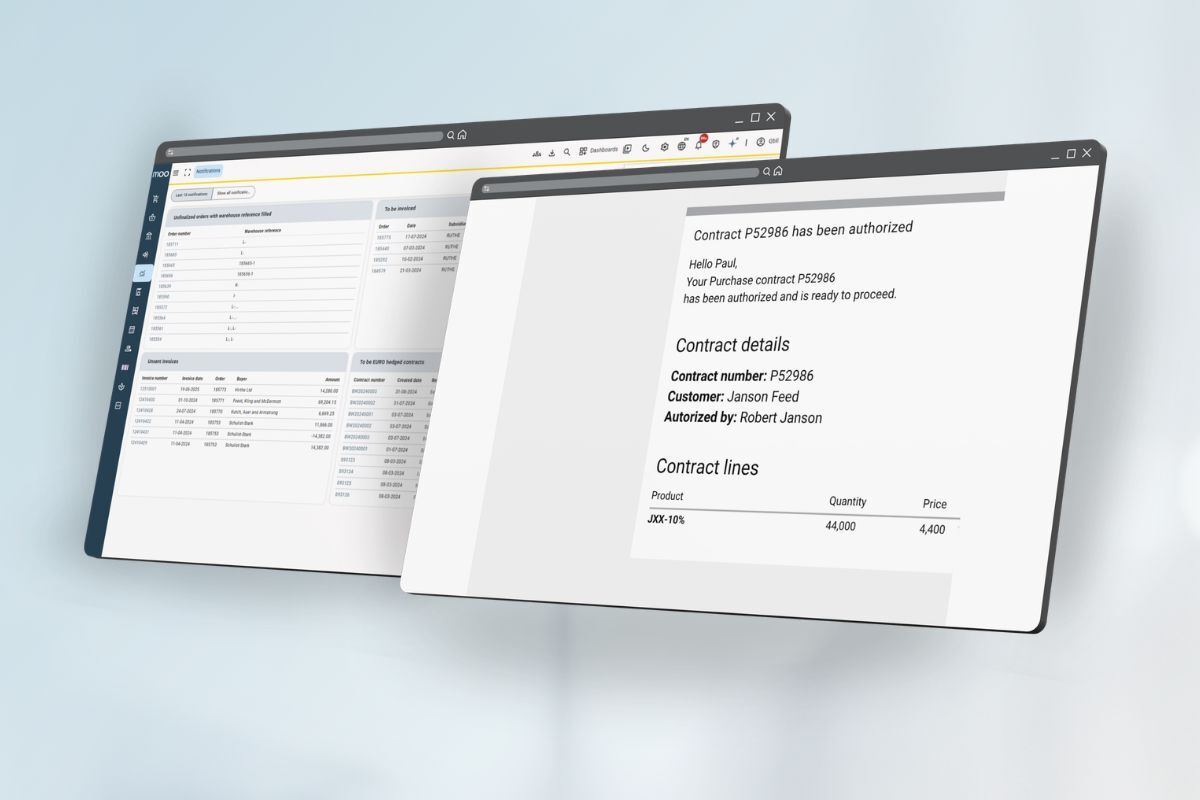
Purpose-built dairy trading software connects contracts, orders, logistics, inventory, and financials in a single live system, so every update is immediately visible to everyone who needs it. Instead of copying data between files, the system carries information forward automatically. A contract entered once flows through to order processing, position management, logistics planning, and invoicing without anyone retyping it.
The practical difference shows up in daily operations. When a contract changes, the position updates. When an order ships, the inventory reflects it. When an invoice is generated, it pulls from the confirmed order data rather than a manually maintained spreadsheet. The chain of information stays intact because the system enforces it, not because a person remembered to update every relevant file.
For dairy ingredient traders specifically, this matters because the product landscape is genuinely complex. Milk powder, whey, butter, cheese, proteins, and plant-based alternatives each carry different logistics requirements, shelf lives, and pricing dynamics. A general-purpose ERP was not built with those specifics in mind. Our dairy trading software was designed around exactly that operational reality, which means the workflows match how ingredient trading actually works rather than forcing traders to adapt a generic system to fit their business.
Real-time position visibility is one of the most significant practical upgrades. Instead of manually reconciling contract commitments against available stock at the end of the day, traders can see their live position at any moment. That kind of visibility supports faster, more confident decisions, which is where margin is made or lost in commodity trading.
When should a dairy trading business stop using spreadsheets?
A dairy trading business should stop using spreadsheets when the cost of maintaining them starts exceeding the cost of replacing them. That tipping point usually arrives before it is recognized. The signals are not always dramatic. They show up as small frictions: a contract error that took hours to trace, a logistics mix-up caused by an outdated file, a new team member who cannot make sense of the existing system, or a growing sense that nobody fully trusts the numbers.
More specifically, consider making the switch when any of the following apply:
- More than one person needs to access and update trading data simultaneously
- Contract volumes have grown to the point where manual reconciliation takes significant time each week
- Position tracking requires pulling data from multiple files to get a complete picture
- A single person leaving the business would make the spreadsheet system unmanageable for others
- Errors have started appearing in invoices, orders, or logistics bookings that trace back to data entry mistakes
- Decision-making feels slower than it should because the data needed is not readily available
The good news is that the transition does not have to be a long or complex project. Unlike large enterprise ERP implementations that take months to configure, a system built specifically for dairy ingredient trading can be operational much faster. We get new environments fully running within two days, which means the barrier to switching is lower than most traders expect.
If any of the situations above sound familiar, it is worth exploring what a purpose-built alternative actually looks like for your operation. You can contáctanos to talk through where your current setup is holding you back and what a connected system would look like in practice.
Preguntas frecuentes
How long does it typically take to migrate our existing spreadsheet data into a purpose-built dairy trading system?
The migration timeline depends on the volume and structure of your existing data, but it is generally much faster than most traders expect. Purpose-built dairy trading platforms are designed to import structured data from spreadsheets, so clean contract, order, and inventory records can often be transferred in a matter of hours rather than days. The bigger time investment is usually in reviewing and cleaning up the data before migration — which is actually a worthwhile exercise in itself, since it often surfaces errors that have been quietly living in the files for months.
What if our team has been using the same spreadsheet system for years — how do we handle the resistance to change?
Resistance to change in spreadsheet-heavy teams almost always comes from two places: familiarity and fear of disruption to an already busy operation. The most effective approach is to involve the people who use the system daily in the evaluation process, so they can see firsthand how a purpose-built tool removes friction from their specific tasks rather than adding new ones. Starting with a focused demo or trial that mirrors real workflows — actual contracts, real product lines, familiar scenarios — makes the difference far more tangible than a feature list ever will. When the team sees that the new system does their current job faster and with fewer errors, the conversation shifts from 'why change?' to 'why didn't we do this sooner?'
Can purpose-built dairy trading software handle the full range of dairy ingredients, or is it optimised for specific products like milk powder?
A well-designed dairy trading platform should handle the full ingredient landscape — milk powder, whey, butter, cheese, proteins, and plant-based alternatives — each with their own logistics requirements, shelf life parameters, and pricing structures. The key differentiator from a generic ERP is that product-specific attributes are built into the system's logic rather than bolted on as customisations. This means workflows like shelf life tracking for whey proteins or multi-currency pricing for butter contracts behave correctly out of the box, without requiring workarounds that would, ironically, push you back toward spreadsheets.
What happens to our real-time position visibility if a contract is amended mid-trade — does the system update automatically?
Yes, and this is one of the most practically valuable differences from a spreadsheet setup. When a contract is amended in a purpose-built system, the change propagates automatically through every connected record — orders, logistics bookings, inventory positions, and financials — without anyone needing to manually update separate files. This means your live position always reflects the most current contractual reality, not the version that existed when someone last remembered to update the relevant tabs. For commodity trading where margins shift quickly, that real-time accuracy directly supports better decision-making.
Is purpose-built dairy trading software a realistic option for smaller trading operations, or is it only suited to large businesses?
It is a realistic and often highly valuable option for smaller operations — in fact, smaller teams frequently see the fastest return on investment because the efficiency gains are proportionally larger relative to headcount. The misconception that specialised software is only for large enterprises comes from legacy ERP experiences, where implementation costs and timelines made adoption impractical for smaller businesses. Modern purpose-built platforms for dairy trading are designed to be operational quickly and do not require a dedicated IT team to maintain, which makes them accessible to lean trading operations that are growing and need their systems to grow with them.
What are the most common mistakes dairy traders make when trying to 'fix' their spreadsheet problems before switching to dedicated software?
The most common mistake is adding more complexity to an already fragile system — building additional tabs, linking files together, or creating elaborate macros that solve one problem but introduce three new dependencies. Another frequent misstep is assigning one person to act as a 'spreadsheet manager' whose job is to keep everything synchronised, which addresses the symptom without fixing the underlying structural problem and creates a single point of failure. These patches can buy time, but they rarely scale, and they often make the eventual migration harder by adding layers of undocumented logic that need to be untangled before clean data can be transferred.
How do we evaluate whether a dairy trading software vendor actually understands the industry, versus just selling a generic tool with a dairy label on it?
The clearest test is to ask the vendor to walk through a workflow that is specific to dairy ingredient trading — for example, how the system handles a bulk milk powder contract with split shipments, variable moisture adjustments, and a multi-currency invoice. A genuinely purpose-built platform will have native support for those scenarios; a rebranded generic tool will require workarounds or customisation to handle them. It is also worth asking about the vendor's existing customer base and whether they have direct experience supporting dairy ingredient traders specifically, since the operational nuances of this market are meaningfully different from general commodity or food trading.