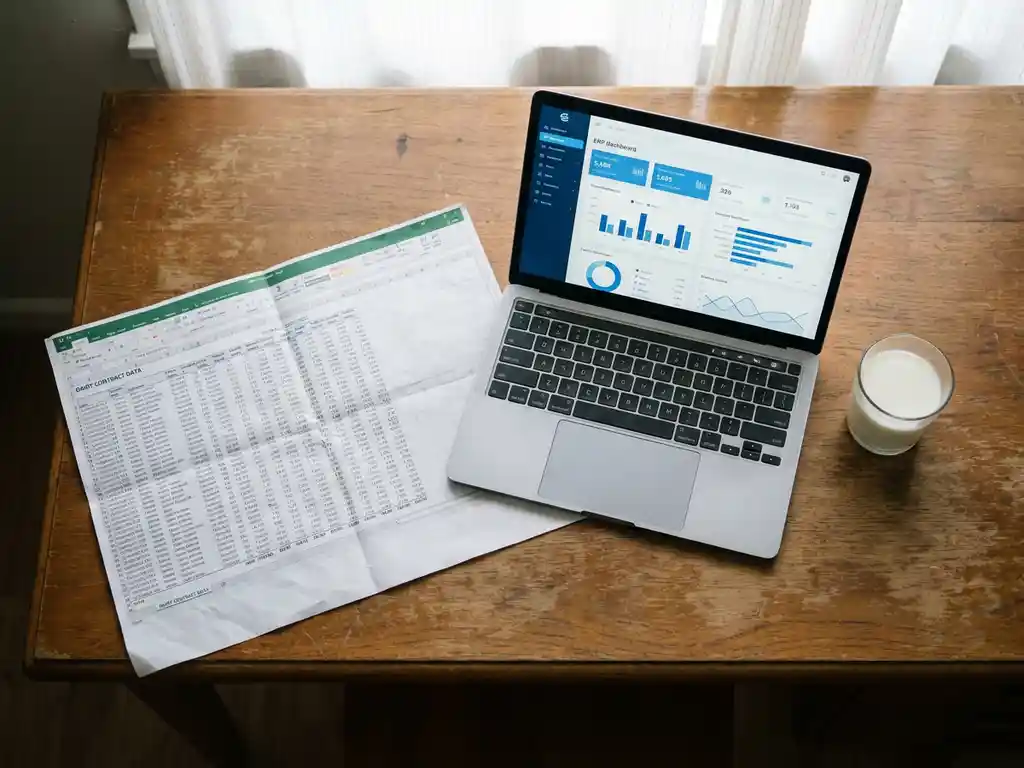
Excel is not good enough for tracking dairy contracts once your trading operation grows beyond a handful of deals. For small, simple setups, it can work as a starting point, but spreadsheets are static by design while dairy trading is dynamic, time-sensitive, and operationally connected across contracts, logistics, and positions. The questions below unpack exactly where Excel falls short and what a better alternative actually looks like.
What actually goes wrong when dairy contracts live in spreadsheets?
When dairy contracts live in spreadsheets, the most common failure is silent: a copied formula carries an error forward for weeks before anyone notices, a version gets saved over, or two people update the same file at the same time and one set of changes disappears. By the time the mistake surfaces, it has already affected orders, invoicing, or customer commitments.
These are not edge cases. They are the predictable result of using a static tool to manage a process that is fundamentally live. Dairy contracts involve multiple moving parts at once: agreed volumes, pricing terms, delivery windows, quality specifications, and counterparty obligations. Each of those elements can change, and when they do, every related cell in every connected spreadsheet needs to be updated manually.
The practical consequences tend to follow a pattern:
- A delivery date changes in an email but never makes it into the spreadsheet
- A contract amendment is saved in a separate file that not everyone has access to
- Two colleagues work from different versions of the same document without realising it
- A customer complaint arrives and nobody can quickly reconstruct what was agreed and when
None of these failures feel dramatic at first. That is exactly what makes them dangerous. The spreadsheet looks fine. The data is technically there. But trust in that data quietly erodes until someone stops relying on it entirely and starts keeping their own notes on the side, which starts the cycle over again.
How do dairy traders typically manage contracts without dedicated software?
Most dairy traders without dedicated software manage contracts through a combination of Excel files, email threads, and shared drives, often supplemented by personal notes and phone calls. This setup evolves organically: one spreadsheet for open contracts, another for invoicing, a folder of PDF confirmations, and an inbox full of amendments. It works well enough when one person handles everything and the volume is manageable.
The problem is that this system was never designed. It grew. And systems that grow without design tend to develop blind spots.
As the team expands, the informal knowledge that held everything together starts to fragment. The person who knew which version of the contract was current, which customer had a standing preference, or which shipment was delayed is now one of several people who each hold a piece of the picture. Coordination happens through messages and meetings rather than through shared, structured data.
This is the moment when the familiar setup stops being a minor inconvenience and starts being a genuine operational risk. Decisions get made on incomplete information. Follow-ups fall through the gaps. And the volume of administrative work grows faster than the volume of actual trade, because every deal now requires more coordination effort to execute cleanly.
Can Excel handle real-time position tracking in dairy trading?
Excel cannot handle real-time position tracking in dairy trading in any meaningful sense. A spreadsheet reflects the data that was entered into it at the moment it was last saved. It has no awareness of what has changed since then, no connection to your orders or logistics, and no way to update automatically when a contract is partially executed or a delivery is confirmed.
Position tracking in dairy trading requires knowing, at any given moment, what you have bought, what you have sold, what is open, what is in transit, and what is already invoiced. That picture changes throughout the day as trades are confirmed, shipments move, and invoices are processed. A spreadsheet can only show you a snapshot of the past.
The practical consequence is that traders working from spreadsheets are always working with slightly outdated information. They compensate by checking in with colleagues, cross-referencing emails, and making judgment calls based on incomplete data. This works until it does not, and in commodity trading the cost of a position error can be significant.
Structured trading software maintains a live position view because every contract, order, and transaction feeds into the same system. When a purchase contract is partially delivered, the open position updates automatically. When an invoice is raised, the financial exposure adjusts. There is no manual reconciliation step because the reconciliation is built into the workflow itself.
What’s the difference between a generic ERP and dairy-specific trading software?
The key difference between a generic ERP and dairy-specific trading software is that a generic system is built around general business processes while a dairy trading system is built around the specific workflows, terminology, and operational logic of buying and selling dairy commodities. A generic ERP can be configured to approximate dairy trading, but that configuration takes significant time, cost, and specialist knowledge to get right.
What a generic ERP gets wrong for dairy traders
Generic ERP systems are designed to serve a wide range of industries. That breadth is their strength for large enterprises with dedicated IT teams, but it becomes a liability for a focused trading business. The data structures, the reporting logic, and the default workflows are built around manufacturing, retail, or services. Mapping dairy contract terms, position management, and commodity-specific logistics onto those structures requires extensive customisation, and customisation adds cost, delays, and ongoing maintenance.
What dairy-specific software gets right from day one
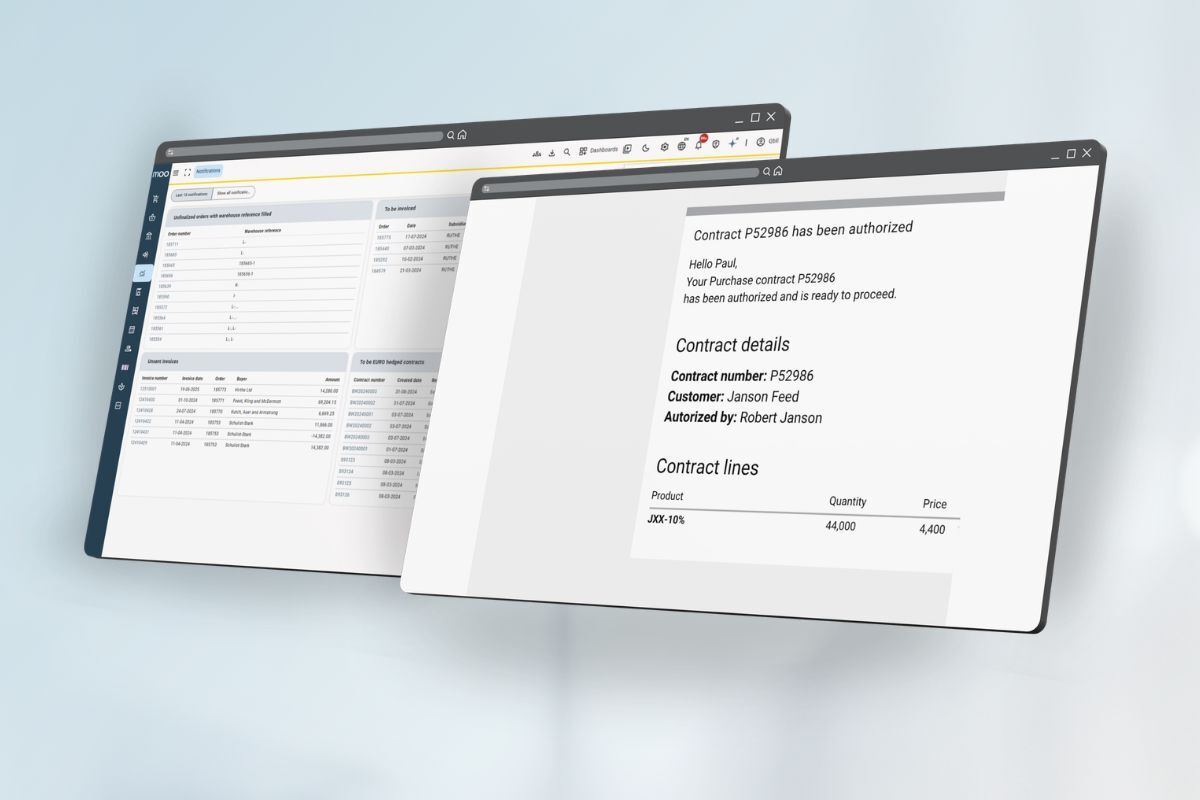
A system built specifically for dairy ingredient trading, like Moo-software, starts from the actual workflows: contract creation with commodity-specific terms, position tracking across bought and sold volumes, logistics coordination tied directly to contract execution, and financial processing connected to your existing accounting tools. The terminology matches what traders actually use. The screens reflect how deals actually flow. There is no translation layer between the software’s logic and your business’s logic, which means less training time, fewer workarounds, and faster adoption across the team.
When should a dairy trading company move away from Excel?
A dairy trading company should move away from Excel when the cost of maintaining spreadsheets, in time, errors, and missed decisions, starts to outweigh the effort of switching to something better. In practice, that moment usually arrives earlier than most teams expect, and the trigger is rarely a single dramatic failure. It is the accumulation of small frictions that each seem manageable on their own.
Watch for these specific signals:
- You spend meaningful time each week reconciling spreadsheets rather than trading
- You are not fully confident in your current open position without double-checking manually
- A new team member has struggled to get up to speed because the system only makes sense to the person who built it
- A contract error or missed delivery has already caused a customer problem
- You are managing more than a handful of active contracts across multiple counterparties
The good news is that moving away from Excel does not have to mean a long, disruptive implementation project. We built Moo Software specifically for dairy ingredient traders who want to get organised without the complexity or cost of a large ERP rollout. Your environment can be fully operational within two days, and the onboardingproces is designed to fit around your trading schedule rather than interrupt it.
If you recognise your current setup in any of the situations described above, it is worth having a conversation about what a more structured approach would look like for your business. You can reach out to us directly and we will walk you through how it works in practice.
Veelgestelde vragen
How long does it typically take to migrate existing dairy contracts from Excel into dedicated trading software?
For most dairy trading operations, migrating active contracts into purpose-built software takes far less time than teams expect. With a system like Moo Software, your environment can be operational within two days, and open contracts can be imported in a structured way rather than re-entered manually. The key is focusing the migration on live, open positions first — historical data can follow once the team is up and running.
What if our team is comfortable with Excel and resistant to changing how we work?
Resistance to change is one of the most common implementation challenges, and it is almost always rooted in a legitimate concern: people do not want to lose familiarity or slow down in the short term. The most effective way to address this is to demonstrate the system using real deals your team already knows, so they can see immediately how it maps to their existing workflow. Dairy-specific software has a significant advantage here because the terminology and screens reflect how traders already think, which shortens the learning curve considerably compared to a generic ERP.
Can dairy trading software integrate with our existing accounting or ERP tools?
Yes — most purpose-built dairy trading platforms are designed to connect with common accounting tools rather than replace them. The goal is to keep financial processing in the system your accounts team already knows while ensuring that contract data, invoicing triggers, and position updates flow through automatically without manual re-entry. Before committing to any platform, it is worth confirming which specific integrations are supported out of the box and what, if anything, requires custom configuration.
What happens to our historical contract data if we switch systems mid-year?
Historical contract data does not need to be abandoned when you switch systems, but it also does not all need to be migrated immediately. A practical approach is to keep closed contracts accessible in a read-only archive — whether that is a locked-down spreadsheet or a document folder — while running all new and open contracts through the new system from day one. This avoids a large upfront migration effort while ensuring your live trading operation is clean and structured from the moment you go live.
Is dedicated trading software worth it for a small dairy trading operation with only a few active contracts?
For a very small operation with genuinely simple, low-frequency deals, Excel can serve as a workable starting point — the post acknowledges this directly. The question to ask honestly is whether your operation is actually that simple, or whether complexity is being absorbed invisibly through extra emails, manual checks, and institutional knowledge held by one or two people. If any of the warning signals described in the post sound familiar, the overhead of dedicated software is almost certainly lower than the hidden cost of the workarounds already in place.
What are the biggest mistakes dairy traders make when trying to fix their spreadsheet problems before switching systems?
The most common mistake is investing heavily in making the spreadsheet more sophisticated — adding more formulas, building macros, or creating elaborate cross-referencing tabs — rather than addressing the underlying limitation, which is that spreadsheets are static and single-user by design. These improvements can feel like progress but they increase complexity and fragility at the same time. The second common mistake is waiting for a serious error to justify the switch, by which point the cost of that error has already been paid.
How do we evaluate whether a dairy trading software vendor actually understands our business before we commit?
The clearest test is to ask the vendor to walk through a real, representative deal from your own operation — not a generic demo. A system built specifically for dairy ingredient trading should handle your contract terms, position logic, and logistics workflow without requiring you to explain what those things mean or how they relate to each other. Pay attention to whether the terminology matches what your team uses day-to-day, and ask specifically how the system handles the edge cases and exceptions that currently cause the most friction in your spreadsheet setup.