
Behind the Scenes
Building Moo Software: Why Specificity Matters in Trading Software
By Faizan – Principal Engineer, Qbil Software
Introduction
When we started what was internally known as Project Qlobal in 2021, the brief was straightforward: build a trading platform for dairy ingredient traders. Not a generic commodity system stretched to fit dairy. A system built around how dairy traders actually work.
That distinction sounds small. In practice, it shapes everything.
Dairy trading has its own logic
Commodity trading software tends to be built around the broadest possible use case. That makes sense for the vendor – one system, many markets. But it creates friction for traders who work in a specific market with specific workflows.
Dairy ingredient trading is a good example. The products: – butter, skimmed milk powder (SMP), whey, and lactose – each have different pricing patterns, contract structures, and delivery cycles. A butter contract looks different from an SMP contract. Seasonal supply patterns affect how traders manage their stock position. GDT auction results move the market twice a month.
A generic system can record these trades. But it won’t be built around them.
What dairy traders actually need
When we spoke to dairy ingredient traders during the development of Moo Software, the requirements were concrete. They weren’t asking for flexibility or configurability. They were asking for clarity.
Three things came up consistently:
Contract positions that are always current. Traders need to know their open purchase and sales contracts at any point in time — not after a manual update or an export. The position has to reflect reality.
Stock positions that make sense. Lot-level stock tracking that matches how dairy ingredients are physically handled — including weight, quality, and location.
No surprises at invoice time. Invoicing that follows directly from contracts and transport records, without manual reconciliation steps in between.
These aren’t unusual requirements. But they need to be built in from the start — not added later as workarounds.
How we built Moo Software
Moo Software shares its core with Qbil-Trade, our CTRM platform for broader commodity trading. That gave us a solid foundation: contract management, transport, stock, P&L, invoicing, and hedging all in one system.
What we adapted for Moo was the focus. We stripped out the modules that don’t apply to dairy trading — LCC and Mass Balance — and made sure the remaining workflows are tuned to what dairy ingredient traders actually do.
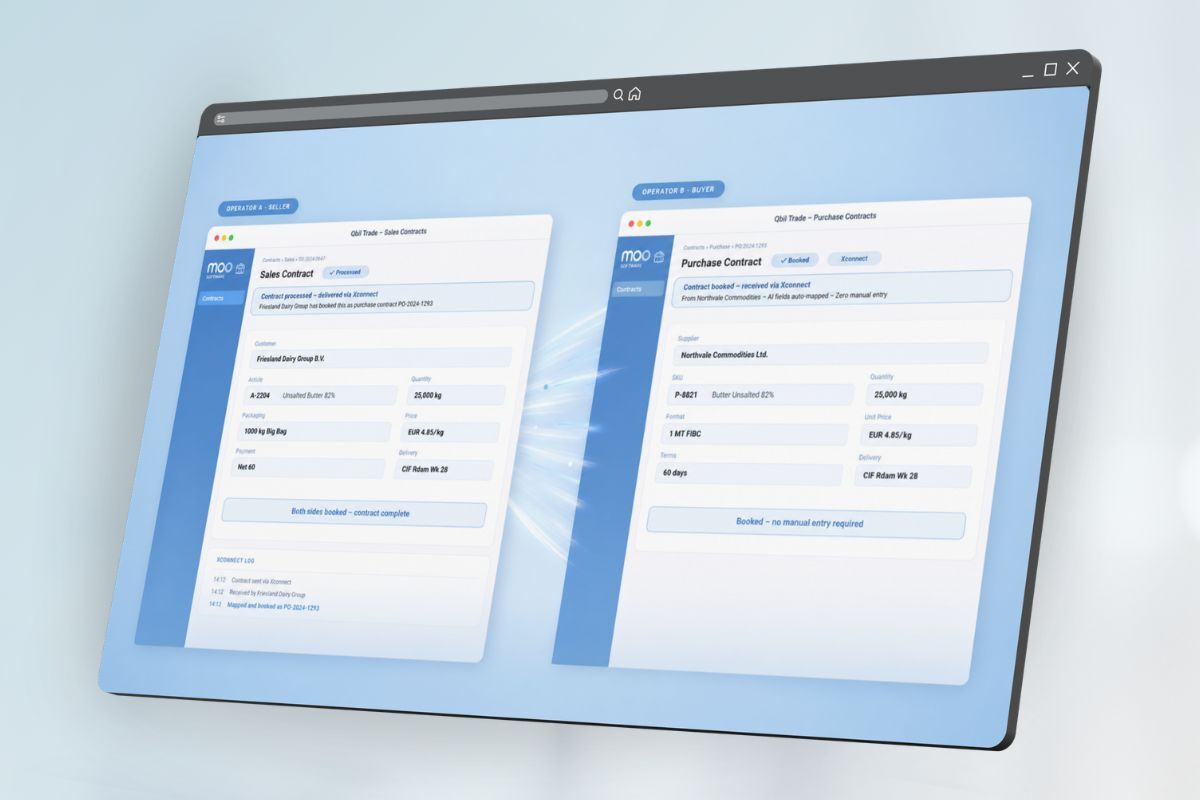
The result is a system that covers the full trading cycle: from purchase and sales contracts through transport and stock to invoicing and P&L — without asking traders to configure their way around features built for other markets.
Three years on
Moo Software has been live since 2022. The core principle hasn’t changed: build for the specific problem, not the generic one.
What has changed is our understanding of the details. Every client we work with teaches us something about how dairy ingredient trading works in practice. That knowledge goes back into the product.
We’re still building on that foundation – and still talking to traders to make sure we’re solving the right problems.
Interested in seeing Moo Software in action? Get in touch or join one of our webinars.