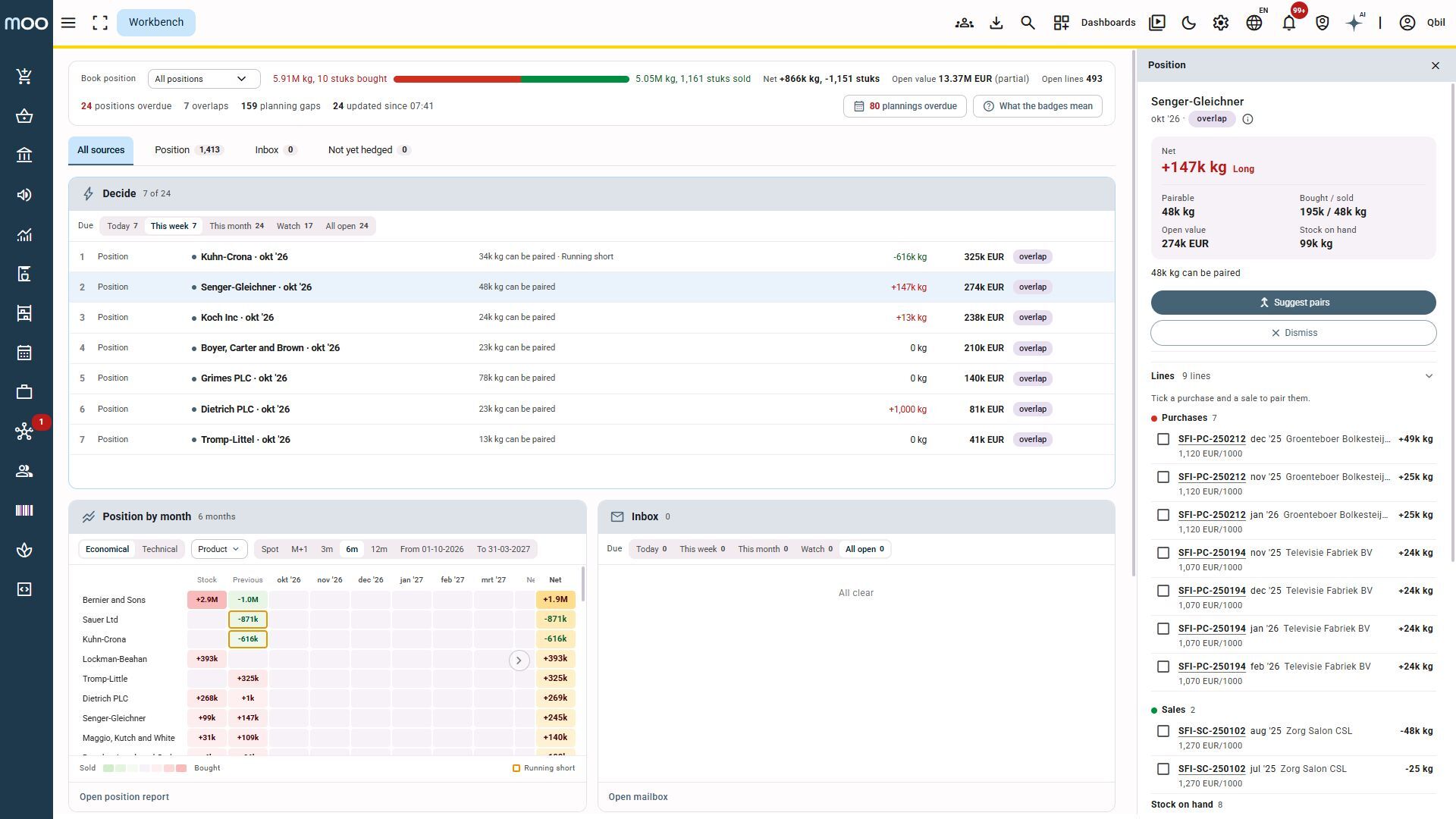
A generic ERP is built around orders, stock and accounting, and fits many types of companies. An ERP built for dairy traders starts from contracts and positions: what you have bought and sold, per product, quality and period, and what still has to be delivered. A generic system can be adapted to work this way, but that takes customisation that you have to pay for and maintain yourself.
What a generic ERP does well
- Accounting, purchasing and sales orders for companies that sell from stock
- Standard processes that are the same in many industries
- A large market of partners and add-ons
For a dairy trader, the gaps are in what happens before the order and around the contract.
Where the differences are
| Generic ERP | ERP built for dairy traders |
|---|
| Starting point | Order and invoice | Contract and position |
| Partial deliveries | Separate orders | Call-offs against one contract |
| Position | Not available, or a separate report | Calculated from contracts, orders and stock |
| Product data | Article and quantity | Quality, specifications, lots, dry matter |
| Back-to-back | Two unrelated orders | Purchase and sale linked |
| Price risk | Outside the system | Futures, currency hedging, mark-to-market |
| Deal result | Per invoice or period | Per contract, from precalculation to P&L |
What customisation costs
Many traders start with a generic ERP and have it adapted. That works, but:
- Every adjustment has to be specified, built and tested, and tested again with every update.
- The knowledge of how the adjustments work sits with one partner or one employee.
- The position often ends up in a separate spreadsheet anyway.
Accounting packages such as Exact or AFAS are good at what they are made for. Many traders keep them for accounting and link a trading system to them, instead of building trading functions into the accounting package. See What should ERP software for dairy traders be able to do that accounting software cannot?
What to watch out for when you compare
- Ask for a demo with your own deals, for example a contract with several call-offs, a back-to-back deal and a purchase in USD.
- Check what is standard and what is customisation. Customisation is not wrong, but you have to maintain it.
- Look at the link with accounting. Your accounting can stay where it is, as long as invoices and relation data flow to it without re-typing.
For a full checklist, see What should you look for in trading software when you trade dairy ingredients?
Generic ERP and Moo Software
Moo is built for dairy ingredient traders. Contracts with call-offs, the position list, back-to-back deals, qualities, lots and dry matter, futures, currency hedging and the precalculation are all standard. Your accounting can stay in the package you use now: invoices and relation data are exported, including to Exact Online. For a comparison per function, see Standard ERP compared to Moo Software.
See it with your own data
Want to see your own deals in Moo next to your current system? Book a demo or contact us.