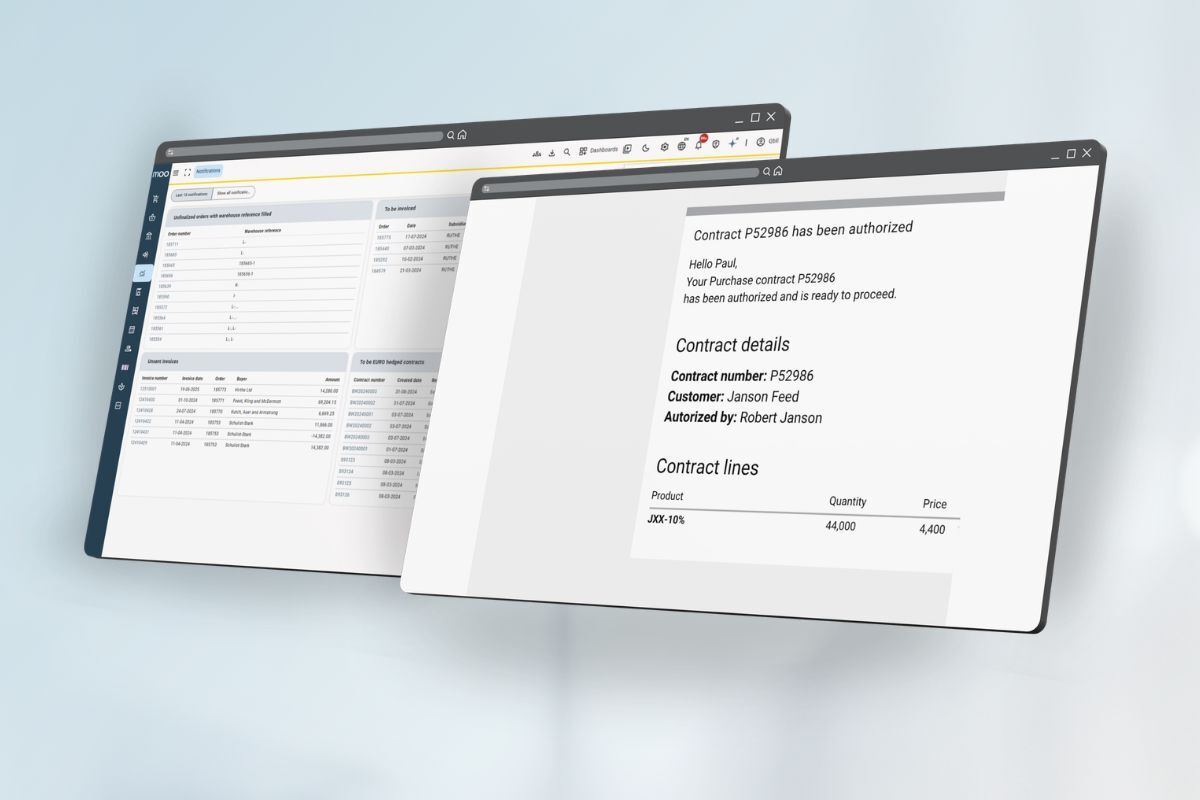

ERP software for the dairy industry provides real-time position tracking by automatically consolidating contract data, purchase orders, sales orders, and inventory levels into a single dashboard. This eliminates manual spreadsheet updates and gives dairy traders instant visibility into their bought-versus-sold quantities, protecting margins and reducing risk exposure in volatile commodity markets.
What does real-time position tracking mean for dairy traders?
Real-time position tracking means having instant visibility into your current trading position across all dairy commodities and ingredients. Unlike traditional spreadsheet methods that require manual updates, real-time tracking automatically calculates the difference between what you’ve bought and what you’ve sold at any given moment.
This immediate visibility is crucial for dairy traders because commodity prices fluctuate constantly throughout the trading day. When you’re dealing with large volumes of milk powder, lactose, or butterfat, even small price movements can significantly impact your margins. Traditional methods leave you vulnerable during the time gap between making trades and updating your records.
The system continuously monitors your open contracts, pending deliveries, and committed inventory levels. This means you always know exactly how much exposure you have in each product category, helping you make informed decisions about new trades without accidentally overcommitting or leaving yourself exposed to market volatility.
How does ERP software automatically calculate trading positions?
Modern ERP systems integrate all your trading data streams into a centralized calculation engine that updates positions instantly when any transaction occurs. The software connects contract management, purchase orders, sales orders, inventory tracking, and delivery schedules to provide automated position calculations without manual intervention.
When you enter a new purchase contract for 50,000 kilos of milk powder, the system immediately updates your long position. If you then sell 30,000 kilos to a customer, it automatically calculates your net position as 20,000 kilos long. This happens across all your products simultaneously, giving you a complete portfolio view.
The automation eliminates the manual tracking errors that commonly occur with spreadsheets. Every transaction flows through the same calculation engine, ensuring consistency and accuracy. The system also factors in quality specifications, delivery dates, and pricing terms, providing a comprehensive view that goes beyond simple quantity tracking.
Why can’t Excel provide the same real-time overview as ERP software?
Excel creates data silos where information exists in separate spreadsheets that don’t communicate with each other automatically. While Excel works well for smaller operations, it requires manual updates across multiple files, creating delays and increasing the risk of human error as your trading volume grows.
The fundamental limitation is that Excel doesn’t integrate with your other business systems. When you receive a new purchase order or confirm a delivery, you must manually update multiple spreadsheets. During busy trading periods, this creates lag time in which your position data becomes outdated, potentially leading to costly decisions based on incorrect information.
Excel also lacks the automated validation that prevents common errors like double-counting transactions or forgetting to update related sheets. As your business grows beyond a certain point, managing positions across multiple products, customers, and suppliers becomes increasingly complex and error-prone with spreadsheet-based systems.
What specific position data do dairy traders need to see instantly?
Successful dairy traders need immediate access to open contract balances, committed inventory levels, pending deliveries with dates, quality specifications for each batch, and current margin calculations across all products. This data must be available at both the individual contract and portfolio levels.
Open contracts show exactly how much you’ve committed to buy or sell that hasn’t yet been fulfilled. Committed inventory levels reveal what physical stock you have allocated to specific customers versus what’s available for new sales. Pending deliveries with precise timing help you manage cash flow and storage capacity.
Quality specifications are particularly important in dairy trading because different customers require different protein levels, moisture content, or other characteristics. Your position tracking must account for these variations since you can’t always substitute one grade for another. Margin calculations help you understand profitability in real time, which is especially important when dealing with the thin margins typical of commodity trading.
How does real-time position visibility improve dairy trading profitability?
Immediate position awareness enables better decision-making by showing exactly when you’re approaching risk limits or identifying profitable arbitrage opportunities between different markets. Real-time visibility prevents overcommitment risk and helps you optimize margin-protection strategies throughout the trading day.
When you can see your exact position instantly, you avoid the costly mistakes that occur with delayed information. You won’t accidentally sell more than you can deliver or miss opportunities to lock in profits when market conditions are favorable. This is particularly valuable in volatile markets where prices can move significantly within hours.
The visibility also supports strategic planning by showing trends in your trading patterns and highlighting which products or customer relationships generate the best returns. You can quickly identify when you’re holding too much inventory of slow-moving products or when you should increase activity in more profitable segments. This data-driven approach leads to more consistent profitability over time.
Real-time position tracking transforms dairy trading from reactive spreadsheet management to proactive business strategy. The immediate visibility into your trading position enables confident decision-making and protects your margins in fast-moving commodity markets. For dairy traders ready to move beyond Excel limitations, professional implementation typically gets your system operational within days, not weeks.
Frequently Asked Questions
How long does it typically take to implement ERP position tracking for a dairy trading operation?
Most dairy trading ERP implementations take 2-6 weeks depending on your current data structure and business complexity. The key factors affecting timeline include data migration from existing spreadsheets, integration with your accounting systems, and staff training requirements. Many companies see initial benefits within the first week as basic position tracking comes online.
What happens if the ERP system goes down - do I lose access to my trading positions?
Quality ERP systems include backup protocols and offline capabilities to prevent trading disruptions. Most cloud-based solutions maintain 99.9% uptime with automatic data backups. Additionally, you can configure alerts and reports to be sent to your mobile devices, ensuring you maintain position visibility even during system maintenance windows.
Can the system handle complex dairy contracts with multiple delivery dates and quality specifications?
Yes, modern dairy ERP systems are specifically designed to manage complex contract structures including partial deliveries, quality premiums/discounts, and seasonal pricing adjustments. The system tracks each contract component separately while maintaining overall position calculations, ensuring accurate reporting even with the most sophisticated trading arrangements.
How does real-time position tracking integrate with my existing accounting and banking systems?
Most ERP solutions offer pre-built integrations with popular accounting platforms like QuickBooks, SAP, and banking APIs for automated transaction reconciliation. This eliminates double data entry and ensures your financial records stay synchronized with your trading positions. Integration typically requires minimal IT support and can often be configured during the initial setup process.
What are the most common mistakes traders make when transitioning from Excel to ERP position tracking?
The biggest mistake is trying to replicate Excel workflows exactly instead of leveraging ERP automation features. Many traders also underestimate the importance of cleaning up historical data before migration and fail to establish proper user permissions from the start. Success comes from embracing the system's automated capabilities rather than fighting them.
How granular can position tracking get - can I see positions by specific dairy grades or customer requirements?
Advanced ERP systems can track positions down to very specific parameters including protein content, moisture levels, packaging requirements, and even supplier certifications. You can view positions by product grade, customer segment, geographical region, or any combination of attributes that matter to your business. This granularity helps optimize inventory allocation and identify the most profitable trading opportunities.
What kind of alerts and notifications should I set up for effective position management?
Essential alerts include position limit warnings (when approaching maximum exposure), margin threshold notifications, delivery deadline reminders, and price movement alerts for open positions. Set up mobile notifications for critical alerts and daily email summaries for routine position updates. The key is balancing comprehensive monitoring with avoiding alert fatigue from too many notifications.