To stay on top of margins, a dairy trader needs real-time visibility into open positions, accurate cost tracking across the full supply chain, and a reliable way to connect contract commitments to actual logistics and invoicing. Without that visibility, margin erosion happens quietly, often before anyone notices. The questions below unpack exactly where the risk hides and what it takes to manage it.
What costs eat into a dairy trader’s margins without warning?
The costs that most often catch dairy traders off guard are not the obvious ones. Freight rate changes, storage overruns, currency fluctuations on international contracts, and small invoicing discrepancies are silent margin killers. They rarely appear as a single dramatic loss. Instead, they accumulate across dozens of transactions until the damage shows up in a monthly reconciliation that nobody saw coming.
Freight is a common culprit. A contract agreed weeks in advance may have been priced against an estimated shipping cost that has since changed. If that update never makes it into the same place where the contract lives, the trader is working with a margin calculation that is already wrong. The same applies to storage. When product sits longer than planned, the daily cost is real, but it rarely triggers an alert in a spreadsheet-based system.
Currency exposure is another area where small trading companies get caught. International dairy ingredient deals often involve multiple currencies, and exchange rate shifts between the contract date and the payment date can quietly compress what looked like a healthy margin. Without a system that tracks these exposures in one place, the full picture only emerges at the end of the month, when it is too late to act.
How do dairy traders track open positions in real time?
Tracking open positions in real time means knowing, at any given moment, what you have bought, what you have sold, what has been delivered, and what is still outstanding. A position is open as long as there is a gap between a purchase commitment and a matching sale, or between a confirmed sale and a completed delivery. Real-time position tracking closes that gap continuously, not just at month end.
In practice, most small dairy trading companies do not track positions in real time. They work from a combination of email threads, shared spreadsheets, and memory. This works reasonably well when volumes are low and the same person handles everything. It starts to break down the moment a second trader joins, a new product line is added, or transaction frequency increases.
The challenge with spreadsheets is structural. A spreadsheet is a static document. It reflects the state of your data at the moment it was last updated, not right now. In dairy trading, where delivery schedules shift, contracts get amended, and logistics change on short notice, a position overview that is even a day out of date can lead to real mistakes. Overselling a position, missing a delivery window, or failing to hedge an exposure are all consequences of position tracking that lags behind reality.
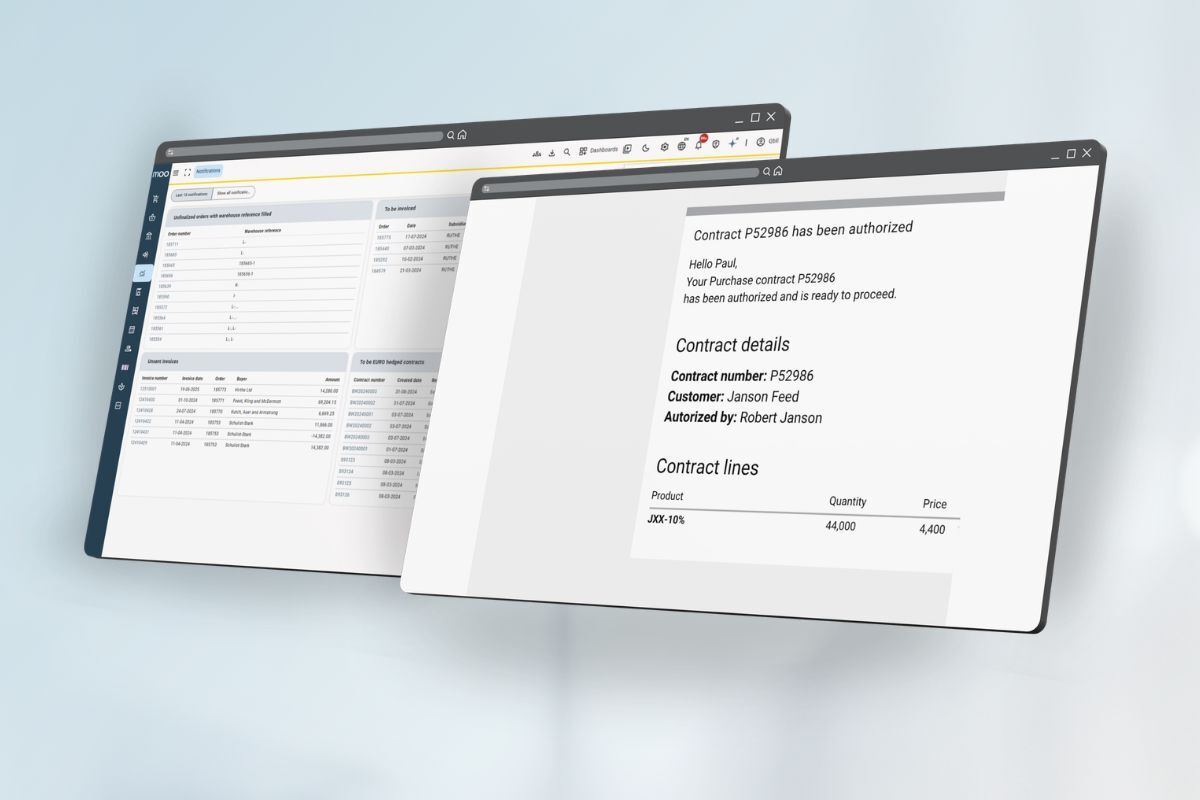
Dedicated trading software for dairy solves this by connecting contract entry, order management, and logistics into a single live system. When a delivery is confirmed or a contract is amended, the position updates automatically. Everyone working in the system sees the same current picture.
Why do small dairy trading companies still rely on spreadsheets?
Small dairy trading companies rely on spreadsheets because spreadsheets genuinely work in the early stages of a business. When one person manages a handful of contracts, a well-structured Excel file is fast, flexible, and free. The problem is not that spreadsheets are bad tools. The problem is that they do not scale, and most companies only discover this after the cracks have already appeared.
There is also a mindset factor. In many smaller trading businesses, the current setup is simply how the industry works. Excel and email have been the standard for so long that the idea of dedicated software for dairy trading feels like something reserved for large corporations with IT departments and implementation budgets. The assumption is that purpose-built ERP software is expensive, slow to set up, and built for businesses much bigger than yours.
This assumption is increasingly outdated. The gap between Excel and trading software has narrowed significantly in terms of cost and setup time, while the operational gap has widened. As transaction volumes grow and more people need to access the same data, spreadsheets introduce a category of risk that is hard to see until something goes wrong. A copied formula error, an overwritten cell, or two people editing different versions of the same file can quietly distort your position overview for days before anyone notices.
The transition away from spreadsheets rarely happens by choice. It usually happens after a missed delivery, a contract dispute, or a margin calculation that turned out to be wrong. Recognizing the problem is the first step, and for many traders, that recognition only comes when the cost of the old system finally becomes visible.
What information does a dairy trader need to make a good deal?
To make a good deal, a dairy trader needs three things at the moment of negotiation: an accurate view of their current position, a reliable cost calculation for the transaction being considered, and enough context about delivery timing and logistics to price the deal correctly. Missing any one of these leads to a deal that looks good on paper but performs poorly in practice.
Position awareness before committing
Before agreeing to a sale, a trader needs to know whether they have the product available, either in stock or through a purchase contract that covers the timing. Without a live position overview, this check happens informally, often through a quick scan of a spreadsheet or a question to a colleague. The risk is that the answer is based on information that is not fully current.
Full landed cost, not just purchase price
A good deal requires knowing the total cost of getting the product to the buyer, not just the purchase price. Freight, storage, insurance, and currency conversion all affect the final margin. Traders who calculate margin based on purchase price alone regularly discover that the actual return is lower than expected once all costs are accounted for. The calculation needs to happen before the deal is agreed, not after.
Timing and logistics clarity
Dairy ingredients have shelf lives, temperature requirements, and certification needs that affect logistics options and costs. A deal that works commercially can still go wrong if the logistics assumptions behind it are incorrect. Knowing lead times, available transport options, and any regulatory requirements for the destination market is part of making a deal that actually delivers the expected margin.
When should a dairy trading company move to dedicated ERP software?
A dairy trading company should move to dedicated ERP software when the cost of not having it starts to exceed the cost of getting it. In practical terms, this usually means one of the following is already happening: data is scattered across multiple spreadsheets that no one fully trusts, more than one person needs to work from the same information at the same time, or margin errors are appearing that cannot be traced back to a single clear cause.
The comparison between Excel and trading software is often framed as a question of size, but it is more accurately a question of complexity. A company with five employees trading in multiple product categories across several countries is already operating at a level of complexity that spreadsheets were not designed to handle. A larger company with straightforward, low-frequency transactions might manage longer. The trigger is complexity, not headcount.
There is also a timing argument. Moving to a dedicated system during a period of growth is significantly easier than doing it during a crisis. When a key employee leaves, a major contract dispute arises, or a logistics failure exposes gaps in your data, the pressure to fix everything at once makes implementation harder. Companies that move proactively, while things are still working, get to set up the system properly and build good habits from the start.
Abbiamo costruito Moo Software specifically for dairy ingredient traders who are at exactly this point. The onboarding process is straightforward, and your environment is fully operational within two days. If you are unsure whether your current setup is still serving you well, it is worth having a conversation before the next problem makes the decision for you. You can contattaci to talk through what your operation looks like and whether dedicated software makes sense for where you are now.
Domande Frequenti
How long does it typically take to migrate from spreadsheets to a dedicated dairy trading system?
For most small to mid-sized dairy trading companies, the migration process is shorter than expected. With a purpose-built solution like Moo Software, your environment can be fully operational within two days. The key is ensuring your existing contract and position data is cleaned up and structured before import — messy data going in will create messy data on the other side, so a brief audit of your spreadsheets before switching is time well spent.
What should I do if I suspect a margin error but cannot pinpoint where it came from?
Start by working backwards from the final invoice and reconciling each cost component — freight, storage, currency conversion, and purchase price — against the original deal assumptions. The discrepancy almost always lives in one of those four areas. If your current setup does not allow you to trace each cost back to a specific contract or transaction, that is a structural gap worth addressing before the next error appears.
Can a small dairy trader manage currency risk without a dedicated treasury or finance team?
Yes, but it requires discipline and the right tooling. The most practical starting point is ensuring that every contract clearly records the agreed currency, the exchange rate at the time of deal entry, and the expected payment date. Even a basic system that flags the gap between contract rate and current rate gives you enough visibility to decide whether to act. Purpose-built trading software handles this automatically, but even a well-structured manual process is significantly better than ignoring the exposure entirely.
How do I know if my current position overview is accurate enough to trade confidently?
A simple test: ask yourself how long it would take to answer the question 'what is my exact net open position across all products right now?' If the honest answer involves opening multiple files, calling a colleague, or waiting until tomorrow, your position tracking has a meaningful lag. Confident trading requires that answer to be available in seconds, not hours — and it needs to reflect deliveries confirmed this morning, not just contracts signed last week.
What are the most common mistakes dairy traders make when calculating landed cost?
The most frequent mistake is using estimated freight rates from a previous deal rather than getting a current quote, especially in volatile shipping markets. A close second is forgetting to factor in storage costs for product that does not move immediately after arrival. Both errors tend to be small on any single deal but compound quickly across a full trading book, and neither shows up until the month-end reconciliation reveals a margin that is consistently lower than projected.
Is dedicated trading software worth it if I only trade one or two dairy product categories?
Product variety is only one dimension of complexity — the more relevant factors are transaction frequency, the number of people accessing shared data, and whether you are trading across multiple currencies or geographies. A trader handling 30 to 40 contracts per month in a single product category across multiple countries is already operating at a level where spreadsheet risk is real. The right question is not how many products you trade, but how much a single data error or missed delivery would cost you.
What should I prioritize when evaluating dairy trading software for the first time?
Focus on three things: how quickly the system connects contract entry to live position tracking, whether it handles full landed cost calculation natively, and how straightforward the onboarding process is. Avoid solutions that require heavy customization or lengthy IT-led implementations — for a small trading operation, a system that is 90% right and live within days is far more valuable than a perfect system that takes six months to deploy. Asking for a walkthrough of a real trading workflow, rather than a feature demo, will tell you quickly whether the software was actually built for the way dairy traders work.