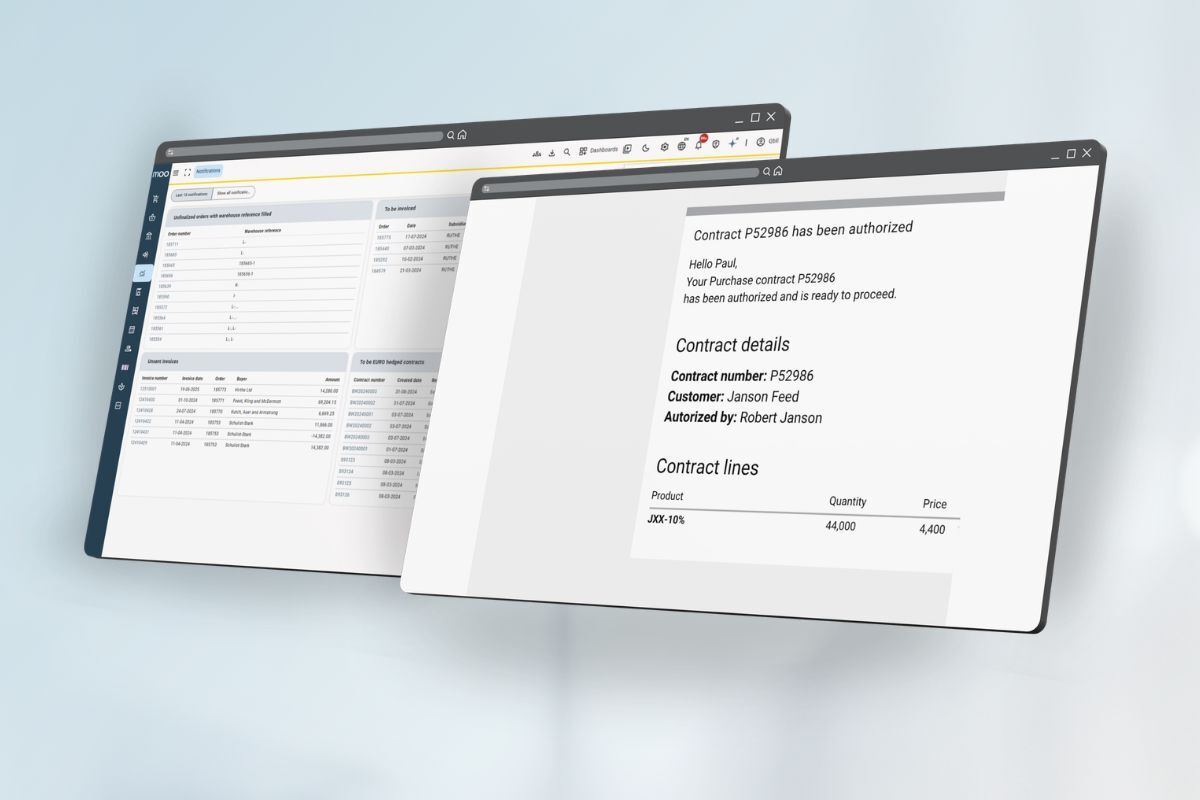
You reduce manual work in a dairy trading operation by replacing disconnected spreadsheets and email threads with a single connected system that handles contracts, orders, inventory, and invoicing in one place. The core problem is not that your team works slowly – it is that information lives in too many separate places, forcing people to re-enter, re-check, and reconcile data by hand. The sections below break down where that manual work comes from, which tasks to address first, and what to look for when choosing software to fix it.
Where does manual work actually come from in dairy trading?
Manual work in dairy trading comes from one root cause: data that is not connected. When a contract is recorded in one spreadsheet, the related order in another, and the invoice in an email attachment, every step between those points requires a person to copy, check, or translate information. Each handoff is a potential error and a guaranteed delay.
Most dairy ingredient traders did not create this situation on purpose. It grew organically. You started with one Excel sheet to track contracts. Then you added another for open positions. Then a colleague made their own version because yours was locked. Before long, the business runs on a collection of files that technically contain all the information but practically make it impossible to see the full picture at once.
The deeper issue is that dairy trading is a real-time business. Prices shift, delivery windows close, and counterparties need fast confirmations. Spreadsheets are static by design. They show you what was true when someone last updated them, not what is true right now. That gap between reality and recorded data is where manual work multiplies and where costly mistakes quietly build up.
Common sources of manual work in dairy trading include:
- Re-entering contract details from email into a spreadsheet or accounting system
- Manually checking whether an order matches the original contract terms
- Updating position overviews by hand every time a trade is confirmed
- Chasing colleagues for the latest version of a shared file
- Reconciling invoices against purchase orders without an automated link
What tasks in dairy trading are easiest to automate first?
The tasks easiest to automate first in dairy trading are the ones that involve moving the same piece of information from one place to another. Contract registration, order confirmation, and invoice generation are the highest-impact starting points because they are repetitive, rule-based, and directly connected to financial accuracy.
When you register a contract in a connected system, that data flows automatically into your open position overview, your logistics planning, and your invoicing workflow. You enter the information once, and the system carries it forward. That single change eliminates a significant share of daily re-entry work without requiring any process redesign.
After contract and order workflows, the next logical area is position management. Knowing your net exposure across open contracts, inventory, and planned deliveries in real time is something spreadsheets genuinely cannot do reliably. A connected system updates your position the moment a trade is booked, so you always see an accurate picture without anyone manually refreshing a pivot table.
Invoicing and accounting reconciliation are also strong early wins. When your trading system connects to your existing accounting software, invoices are generated from confirmed orders rather than being typed from scratch. This removes a class of errors that are common and expensive: wrong quantities, wrong prices, wrong counterparty details.
How does connected software reduce errors in contract and order management?
Connected software reduces errors in contract and order management by making it impossible to have two conflicting versions of the same data. When a contract is entered once and flows automatically into orders, logistics, and invoicing, there is no manual transcription step where a number can be misread, a date can be transposed, or a unit can be entered incorrectly.
In a fragmented setup, the same contract might be referenced in a sales email, a shared spreadsheet, a logistics instruction, and an invoice – each created separately by a different person at a different time. The risk is not that your team is careless. The risk is structural: the more times information is copied, the more chances there are for it to diverge. One misplaced decimal or a copied formula that quietly breaks can distort results for weeks before anyone notices.
A connected system also creates a clear audit trail. When something does go wrong – a quantity dispute with a supplier, a delivery timing question from a customer – you can trace exactly what was agreed, when it was confirmed, and what changed. That traceability is almost impossible to maintain manually across multiple files and email threads.
For international dairy ingredient traders specifically, this matters even more. You may be managing contracts in multiple currencies, with different delivery terms, across counterparties in several countries. The margin for error in that environment is thin, and the cost of a mistake is real. Connected contract and order management is not a luxury in that context; it is a basic operational requirement.
When does manual work in dairy trading become a real business risk?
Manual work in dairy trading becomes a real business risk when the volume of activity outgrows the capacity of one person to hold everything in their head. For most trading businesses, that moment arrives earlier than expected – often around the time a second or third colleague joins and the shared spreadsheet stops being something one person fully controls.
The clearest warning signs are:
- A contract error reaches a customer before anyone internally caught it
- A delivery is missed because the logistics instruction was based on an outdated version of a file
- A key person is away, and no one else can find or interpret the data they maintained
- Month-end reconciliation takes days because invoices, orders, and contracts have to be matched by hand
- You cannot answer a basic question – like your total open position in butter – without asking someone to go and check
Each of these is a signal that the system has reached its limit. The business is still running, but it is running on individual knowledge and manual effort rather than on reliable process. That is a fragile position. It means the risk does not just sit in your operations; it sits with your people. When someone leaves, gets sick, or simply makes a tired mistake on a Friday afternoon, the exposure becomes visible very quickly.
In 2026, with margins under pressure and customers expecting faster turnaround times, the cost of that fragility is higher than it used to be. The question is not whether your current setup will eventually fail you. It is whether you fix it before or after something goes wrong.
What should dairy traders look for in software that reduces manual work?
Dairy traders should look for software that is built specifically for ingredient and commodity trading, connects all core workflows in a single system, and can be operational quickly without a lengthy implementation project. Generic ERP systems can technically be configured for dairy trading, but the configuration work is expensive, and the result rarely fits the way commodity trading actually operates.
The most important capabilities to evaluate are:
- Contract and position management: The system should give you a real-time view of open contracts, inventory, and planned deliveries without manual updates.
- Order and logistics workflow: Orders should flow from contracts automatically, with logistics instructions generated from confirmed order data rather than re-entered separately.
- Accounting integration: The software should connect to your existing accounting system so invoices are generated automatically and reconciliation is handled without manual matching.
- Multi-currency and international trade support: If you trade across borders, the system needs to handle different currencies, delivery terms, and document requirements without workarounds.
- Speed of implementation: A long setup process means months of continued manual work and risk. Look for a solution that can have your environment running within days, not quarters.
It is also worth asking whether the software was built by people who understand commodity trading. A system designed for manufacturing or retail will approach inventory, contracts, and pricing in fundamentally different ways than one built for trading. The closer the software’s logic is to the way you already think about your business, the less time you spend working around it.
Wir haben gebaut Moo Software specifically for dairy ingredient and commodity traders for exactly this reason. If you are curious whether it fits your operation, get in touch and we can walk through what your setup would look like in practice.
Häufig gestellte Fragen
How long does it typically take to migrate from spreadsheets to a connected dairy trading system?
For a purpose-built dairy trading platform, migration can often be completed within days to a few weeks, depending on the volume of historical data you want to bring across and the complexity of your existing workflows. The key is choosing software designed specifically for commodity trading — these systems require far less configuration than generic ERP tools, which means less time spent on setup and less disruption to live trading activity. A practical approach is to start with current open contracts and positions rather than attempting a full historical migration before going live.
What if my team is resistant to switching away from spreadsheets they know well?
Resistance to change is normal, and it is almost always rooted in a legitimate concern: people worry that a new system will slow them down during the learning curve. The most effective way to address this is to involve key users early, show them specifically how the new workflow replaces tasks they currently find frustrating, and choose software with an interface close enough to trading logic that it feels intuitive rather than foreign. A short, focused onboarding period with real data from your own business — rather than generic demos — tends to convert skeptics faster than any top-down mandate.
Can a connected trading system still work if not all of my counterparties use digital processes?
Yes — the value of a connected system is internal consistency, not external dependency. Even if a supplier sends contracts by email or a customer confirms orders by phone, your team enters that information once into the system and everything downstream (position updates, logistics instructions, invoicing) flows automatically from that single entry point. The manual step of receiving information from a counterparty does not disappear, but every subsequent step inside your operation does. Over time, many traders also find that having clean, traceable data internally makes it easier to push counterparties toward more structured communication formats.
How do I know which of my current manual processes are costing me the most?
A straightforward way to identify the highest-cost manual processes is to track where errors are discovered and where month-end reconciliation takes the longest. If invoice corrections, position discrepancies, or delivery mismatches come up repeatedly, those workflows are your priority. It is also worth asking your team which tasks they dread most or which ones require them to interrupt other work to chase down information — those friction points are reliable indicators of where automation will deliver the fastest return. A short process audit, even an informal one over a week, usually surfaces the same two or three bottlenecks consistently.
Is a purpose-built dairy trading system suitable for smaller operations, or is it only worth it at scale?
Purpose-built trading software is often most valuable for smaller and mid-sized operations, precisely because those businesses cannot afford a dedicated team to manage spreadsheet chaos or absorb the cost of errors that a larger organization might absorb more easily. The efficiency gains — fewer re-entry steps, real-time position visibility, automated invoicing — have the same structural impact regardless of volume. The key question is not how large you are today, but whether the current setup is already creating risk or limiting your capacity to take on more business without adding headcount.
What happens to our audit trail and historical data when we switch systems?
Most purpose-built trading platforms allow you to import historical contract and transaction data so that your records remain accessible and traceable after the switch. At a minimum, you should ensure that your historical spreadsheets and email records are archived in an organized, searchable format before going live — this protects you for any retrospective disputes or compliance queries. Going forward, a connected system creates a far more reliable audit trail than spreadsheets ever could, because every change, confirmation, and update is timestamped and linked to the relevant contract or order automatically.
What is the biggest mistake dairy traders make when trying to reduce manual work on their own?
The most common mistake is trying to fix a structural problem with a process solution — adding more spreadsheet tabs, stricter naming conventions, or a shared folder system to manage the chaos rather than replacing the disconnected setup that causes it. These fixes reduce friction temporarily but do not address the root cause: data that is not connected cannot be kept consistent by process discipline alone, especially as volume and team size grow. The second most common mistake is delaying the switch until after something goes wrong, at which point the cost of the problem often exceeds the cost of the solution that would have prevented it.