Yes, you can run a dairy trading business on Excel — but only up to a point. For small operations handling a handful of contracts, a well-organised spreadsheet can do the job. The problem is that dairy trading is dynamic, multi-person, and time-sensitive by nature, and Excel was never built for that. Once your volume grows, your team expands, or your contracts get more complex, the cracks start to show quickly. Below, we unpack the most common questions dairy traders ask when they start wondering whether their current setup is still working for them.
What happens when your dairy trading operation outgrows Excel?
When a dairy trading operation outgrows Excel, the first sign is usually not a dramatic failure but a slow erosion of confidence in your own data. Decisions start taking longer because nobody is quite sure which version of the file is current. Entries get missed, duplicated, or overwritten. What once felt like a manageable system quietly becomes a source of daily friction rather than a reliable tool.
The core issue is structural. Excel is a single-user tool at heart. Even with shared drives or cloud versions, it was not designed for multiple people updating the same data simultaneously across contracts, orders, and stock positions. In dairy trading, where a contract agreed in the morning can affect logistics planning by the afternoon, that limitation has real consequences.
As your operation grows, you add more files to compensate. One sheet for open contracts, another for deliveries, a separate one for invoicing, perhaps a few more for tracking specific customers or product lines. Each new file solves an immediate problem but adds another layer of disconnection. The data technically exists, but it is scattered across documents that do not talk to each other. At some point, pulling together an accurate picture of your current position requires hours of manual work rather than a single glance.
What are the biggest risks of managing dairy contracts in spreadsheets?
The biggest risks of managing dairy contracts in spreadsheets are silent errors, version confusion, and the absence of any audit trail. A copied formula that pulls from the wrong cell, a row accidentally deleted, or a figure entered in the wrong column can distort your data for days or weeks before anyone notices. By then, decisions have already been made on faulty information.
In the context of Excel vs trading software, this distinction matters enormously. Dedicated trading software records every change, flags inconsistencies, and keeps a clear history of who did what and when. Spreadsheets do none of this by default.
Version confusion and the wrong file problem
When multiple people are involved in a trading operation, file versioning becomes a constant hazard. Someone emails a contract summary, a colleague updates their local copy, and within hours there are two conflicting versions of the same data. The person making the next decision does not always know which one to trust. In dairy trading, where contract terms, volumes, and delivery dates change frequently, this kind of confusion is not just inconvenient — it is a genuine operational risk.
The hidden cost of manual reconciliation
Every hour spent cross-checking files, re-entering data from emails, or manually reconciling invoices against contracts is an hour not spent on trading. For smaller teams, this overhead is disproportionately damaging. It is not just a time cost — it is also a cognitive one. When people spend their energy on data hygiene rather than decision-making, the quality of those decisions tends to suffer.
How do successful dairy traders keep track of stock positions in real time?
Successful dairy traders keep track of stock positions in real time by moving away from static files and into systems where contracts, orders, and inventory are all connected. When a contract is confirmed, stock positions update automatically. When a delivery is logged, the relevant figures adjust across the board. There is no manual step in between, and no risk of one update being missed while another goes through.
This kind of real-time visibility is what separates traders who can make fast, confident decisions from those who need to spend time gathering information before they can act. In a market where prices and availability shift quickly, the ability to see your exact position at any given moment is a genuine competitive advantage.
The contrast with spreadsheet-based operations is stark. In Excel, your position is only as current as the last time someone updated the file. If that was yesterday afternoon, or this morning before a new order came in, your view of the world is already out of date. For dairy traders dealing with perishable goods and tight delivery windows, that lag is not a minor inconvenience — it is a structural weakness.
What should dairy trading software actually do that Excel cannot?
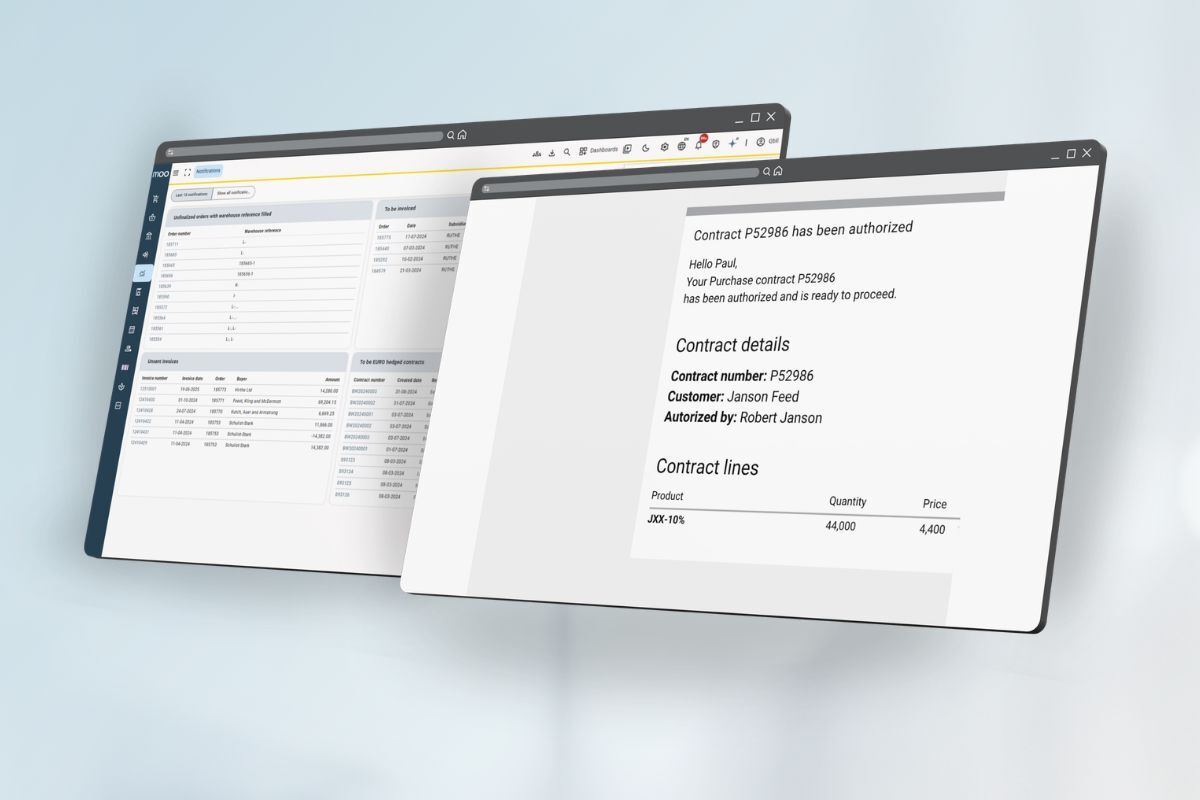
Dairy trading software should connect your contracts, orders, logistics, stock positions, and financials into a single live system where every action updates the whole picture automatically. Excel can store data, but it cannot enforce workflows, trigger alerts, or keep multiple users in sync without significant manual effort. Purpose-built software removes those limitations entirely.
Beyond connectivity, there are several specific capabilities that spreadsheets simply cannot replicate in a practical way.
- Automatic position management: When a contract is signed or an order is placed, your stock position updates immediately without any manual entry.
- Integrated order and logistics tracking: From contract to delivery, every step is recorded in the same system, reducing the risk of missed handoffs or miscommunication.
- Accounting system integration: Transactions flow automatically into your bookkeeping, eliminating double entry and the errors that come with it.
- Multi-user access with clear ownership: Everyone on your team sees the same data at the same time, and there is always a clear record of who made which change.
- Audit trails and contract history: Every version of a contract, every amendment, every approval is logged and retrievable — something Excel cannot do reliably.
Il nostro software per il commercio di latticini was built specifically around how ingredient and commodity traders actually work, which means these capabilities are not bolt-ons — they are the foundation of the system.
When is the right time to move away from Excel in a dairy business?
The right time to move away from Excel in a dairy business is before something goes seriously wrong, not after. In practice, most traders make the switch when they recognise one or more of the following: they are spending more time managing their data than acting on it, they have experienced a costly error tied to a spreadsheet mistake, or their team has grown to the point where file sharing no longer works reliably.
There is no single threshold that applies to every operation. A two-person team trading a narrow product range might manage comfortably in Excel for years. A five-person team handling multiple product lines, several active contracts at once, and regular international shipments will hit the ceiling much sooner.
The clearest signal is this: if you cannot tell someone your exact open position, pending deliveries, and outstanding invoices in under a minute without opening multiple files, your current system is already costing you more than you realise. That is not a technology problem — it is an operational one, and it gets harder to solve the longer you wait.
The good news is that switching does not have to be a major project. With the right system, your environment can be fully operational within a matter of days, not months. If you are curious about what that transition looks like in practice, you are welcome to get in touch and we can walk you through it.
Domande Frequenti
How long does it typically take to migrate from Excel to dedicated dairy trading software?
For most small to mid-sized dairy trading operations, migration can be completed within a few days to a couple of weeks, depending on the volume of historical data you want to bring across and how many active contracts need to be transferred. The key is choosing software built specifically for commodity trading, as it will already reflect the workflows you use rather than requiring heavy customisation. A good provider will guide you through the setup process and help you go live without disrupting day-to-day trading.
Can I keep using Excel alongside trading software during the transition period?
You can, but it is worth keeping that overlap period as short as possible. Running two systems simultaneously creates the same version confusion and data fragmentation that prompted the switch in the first place. A cleaner approach is to use Excel as a read-only reference for historical records while all new contracts, orders, and positions are entered exclusively into the new system from day one. This keeps your team aligned and avoids the temptation to revert to old habits.
What if my dairy trading operation is still small — is purpose-built software worth it at this stage?
The honest answer depends on your growth trajectory rather than your current size. If you are handling a stable, narrow range of contracts with no plans to scale, Excel may remain workable for now. However, if you are actively growing your volume, product range, or team, adopting proper software early is significantly easier than retrofitting it later when your data is already scattered across dozens of files. The operational habits you build now will either support or constrain your growth.
How does dairy trading software handle contract amendments and renegotiations?
Purpose-built trading software logs every amendment as a new version of the contract, preserving the full history of what was agreed, changed, and when. This means you can always trace back to the original terms, see who approved a change, and understand how a contract evolved over its lifetime. In Excel, amendments are typically handled by overwriting existing data or creating new file versions, which makes it almost impossible to reconstruct a reliable audit trail after the fact — a significant risk in any dispute or compliance review.
What are the most common mistakes dairy traders make when trying to scale up their Excel setup instead of switching?
The most common mistake is adding more files and tabs to solve problems that are fundamentally about connectivity, not storage. Traders often build elaborate macro-driven workbooks or link multiple spreadsheets together, which creates a fragile system that breaks whenever a file is moved, renamed, or updated by the wrong person. Another frequent error is underestimating the cumulative time cost of manual reconciliation — what feels like a minor daily inconvenience often adds up to dozens of hours per month that could be spent on actual trading decisions.
Does switching to trading software mean my team needs significant technical training?
Not if you choose the right system. Software designed specifically for dairy and commodity traders should reflect the language and workflows your team already uses — contracts, positions, deliveries, invoices — rather than requiring you to learn a generic platform and adapt it to your business. Most traders find that onboarding is straightforward precisely because the system mirrors how they already think about their operation, just without the manual overhead that comes with spreadsheets.
How does real-time position tracking in trading software actually affect day-to-day decision-making?
The practical impact is that you can respond to market changes, customer requests, or supply issues immediately rather than needing to gather and verify data first. For example, if a buyer calls asking whether you can fulfil an additional order, you can confirm your available position in seconds rather than opening three files and doing manual calculations. Over time, this speed and confidence compounds — traders who always know their exact position are better placed to move quickly when opportunities arise and to avoid overcommitting when stock is tight.