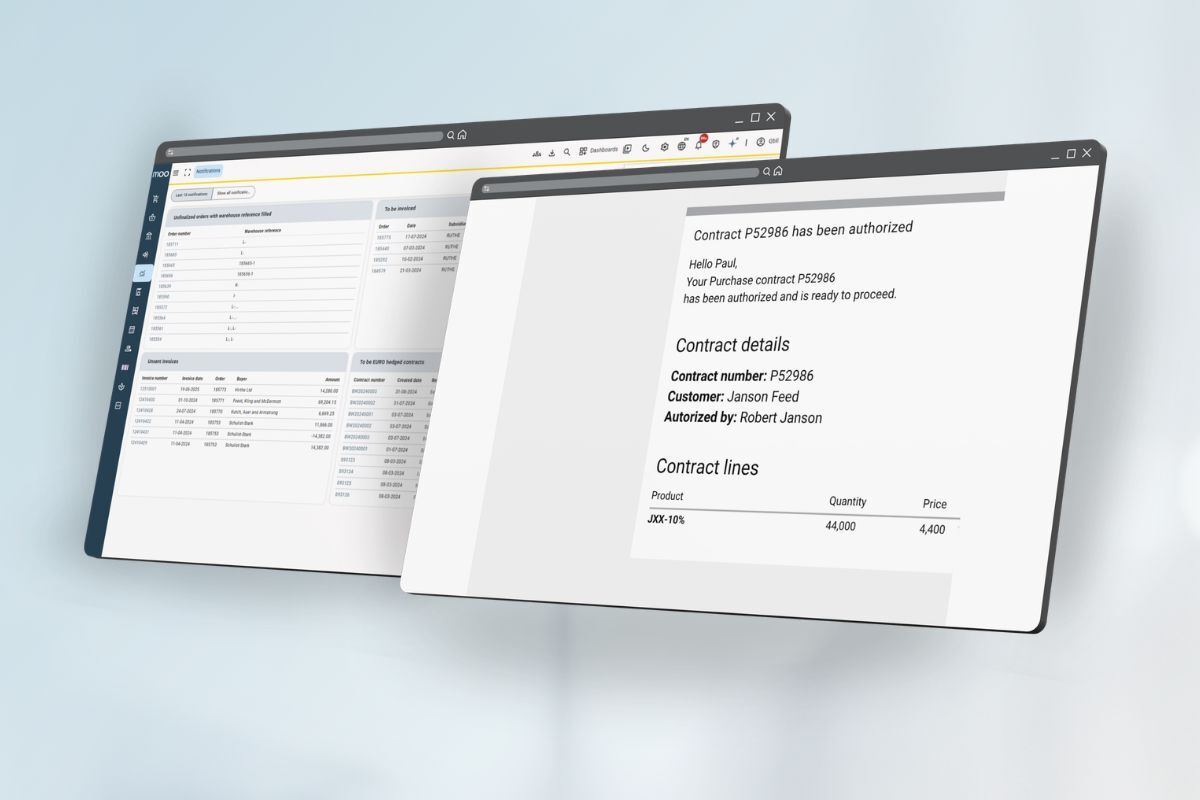

Most dairy traders manage contracts through a combination of spreadsheets, email threads, and shared documents — methods that work well enough when volume is low but become increasingly fragile as a trading operation grows. The reality is that many small and mid-sized dairy trading companies have never used dedicated contract management software because they never knew it existed for their specific type of business. This article walks through how manual contract management actually works in practice, where it breaks down, and what a better alternative looks like.
What does contract management actually look like in dairy trading?
In most dairy trading businesses, contract management means maintaining a running record of purchase and sales agreements across spreadsheets, email inboxes, and sometimes printed documents. Each contract captures the counterparty, product, quantity, price, delivery terms, and payment conditions — and keeping all of that current, accurate, and accessible is the daily challenge.
In practice, a trader might open a new row in a spreadsheet each time a contract is agreed, then update it manually as orders are placed, shipments are confirmed, and invoices go out. A separate tab might track open positions. Another file might log logistics. And somewhere in an email chain sits the original confirmation that contains the terms everyone is working from.
This approach is not unique to dairy trading — it is how many commodity trading businesses operate when they are starting out or growing gradually. The problem is not that spreadsheets are bad tools. The problem is that dairy trading is dynamic, multi-party, and time-sensitive, and spreadsheets are static by design.
Why do so many dairy traders still rely on Excel and email?
Dairy traders rely on Excel and email because these tools were available from day one, they require no implementation, and they work well enough for a small number of contracts. When a business starts with ten contracts a month, a spreadsheet is a perfectly reasonable solution. The issue is that most traders never consciously decide to keep using it — they simply never stop.
There is also a cultural dimension. In many dairy trading circles, the assumption is that this is simply how the industry works. Excel and email are so deeply embedded in day-to-day operations that the idea of a purpose-built alternative rarely surfaces. Traders are busy people. If the current system is not visibly breaking, the question of whether there is a better way rarely gets asked.
Another factor is familiarity. Everyone on the team already knows how to use a spreadsheet. Introducing new software feels like a disruption — a cost in time and effort that is hard to justify when the current approach is still technically functioning. The threshold for change only appears when something goes wrong.
What goes wrong when contracts are managed manually?
When contracts are managed manually through spreadsheets and email, the most common failure is silent data drift — small errors that accumulate unnoticed until they cause a visible problem. A copied formula that pulls from the wrong column, a quantity updated in one file but not another, or a delivery date that was verbally revised but never reflected in writing can all distort the picture without anyone realising it immediately.
Beyond formula errors, manual contract management creates gaps in visibility. When one person holds the master spreadsheet and another manages logistics, there is always a lag between what has happened and what the rest of the team knows. In dairy trading, where prices shift quickly and delivery windows are tight, that lag has real consequences.
Some of the most common failure points include:
- Duplicate or conflicting contract versions saved across multiple locations
- Missed delivery deadlines because logistics were tracked separately from contract terms
- Invoicing errors caused by outdated quantity or price data
- Disputes with counterparties over terms that were never formally confirmed in writing
- A key employee leaving and taking institutional knowledge with them
None of these failures are dramatic on their own. But they compound. A customer complaint about a late delivery traces back to a logistics entry that was never updated. A margin calculation is off because the price revision from three weeks ago only made it into one of the two spreadsheets. These are the moments when traders realise the system they trusted was more fragile than it appeared.
How do traders keep track of open positions without dedicated software?
Without dedicated software, dairy traders typically track open positions through a manually maintained summary spreadsheet that lists all active purchase and sales contracts, their quantities, and the degree to which they have been fulfilled. This position overview is usually updated by one person and shared with the team at intervals — daily, weekly, or whenever someone asks.
The fundamental limitation of this approach is that it is always slightly out of date. The moment a new order is placed or a partial shipment is confirmed, the position overview is no longer fully accurate until someone updates it. In a low-volume operation, this lag is manageable. As volume grows and more people are involved, the gap between the real position and the recorded position widens.
Traders compensate for this in various ways — morning check-in calls, shared inboxes, colour-coded spreadsheet tabs — but these workarounds add coordination overhead without solving the underlying problem. Real-time position visibility requires a system where every transaction updates the position automatically, which is something spreadsheets simply cannot do.
When does manual contract management stop being good enough?
Manual contract management stops being good enough when the cost of errors, coordination, and oversight begins to outweigh the effort of switching to a structured system. For most dairy trading businesses, this tipping point arrives somewhere between twenty and fifty active contracts, or when a second or third person joins the operation and needs access to the same information.
The clearest signals that manual management has reached its limit include:
- Contracts being missed or double-booked because no single source of truth exists
- Time spent reconciling spreadsheet versions rather than trading
- Decisions being delayed because the current position is unclear
- New staff unable to get up to speed quickly because knowledge lives in files rather than systems
- Growing anxiety around audits or counterparty disputes because documentation is inconsistent
The honest answer is that many traders reach this point earlier than they expect. The transition from manageable to chaotic does not happen gradually — it tends to happen suddenly, triggered by a single bad month or a single costly error. Waiting for that trigger is a common pattern, but it is not a necessary one.
What should dairy traders look for in contract management software?
Dairy traders should look for software that is built specifically for commodity and ingredient trading rather than adapted from a generic ERP system. The core requirement is a connected workflow where contracts, orders, logistics, positions, and invoicing all live in the same environment and update each other automatically. This eliminates the data drift that makes manual management unreliable.
Beyond connectivity, the most important criteria for dairy trading businesses include:
- Real-time position management: The ability to see open purchase and sales positions at any moment, without manual reconciliation
- Contract-to-invoice traceability: Every invoice should trace directly back to a contract, with quantities and prices automatically carried through
- Multi-currency and international trade support: Dairy ingredient trading is inherently cross-border, so the system needs to handle different currencies, incoterms, and documentation requirements
- Integration with existing accounting tools: Automatic transaction processing through links to bookkeeping systems removes a significant source of manual error
- Fast implementation: A system that takes months to configure is a barrier to adoption; look for solutions that can be operational quickly
It is also worth considering whether the software provider understands the dairy industry specifically. A system built by people who understand how milk powder, butter, and whey powder are actually traded will handle the nuances of the business in ways that a generic solution simply will not.
Abbiamo costruito Moo Software specifically for dairy and plant-based ingredient traders who want this kind of connected oversight without the complexity of a large ERP rollout. If you are wondering whether your current setup is holding your business back, get in touch and we can walk through what a transition would actually look like for your operation.
Domande Frequenti
How long does it typically take to migrate from spreadsheets to dedicated dairy trading software?
For most small to mid-sized dairy trading operations, the migration process can be completed in a matter of days to a few weeks — not months. The key is choosing software purpose-built for commodity trading, where your existing contract data (counterparties, products, quantities, prices) can be imported directly rather than rebuilt from scratch. A good software provider will guide you through onboarding and ensure your team is operational quickly, minimising disruption to live trading activity.
What happens to our historical contract data when we switch to a new system?
Most dedicated trading platforms allow you to import historical contract data from spreadsheets or CSV exports, so you do not lose your records or have to start from zero. It is worth auditing and cleaning your existing data before migration — removing duplicate entries, resolving version conflicts, and confirming that quantities and prices are accurate. Think of the transition as an opportunity to establish a single, reliable source of truth from day one in the new system.
Can contract management software handle the complexity of dairy trading — different product grades, incoterms, and international documentation?
Yes, but only if the software was designed with commodity and ingredient trading in mind. A system built specifically for dairy trading will natively support product specifications (fat content, moisture levels, packaging formats), standard incoterms, multi-currency pricing, and trade documentation such as certificates of origin or quality certificates. Generic business software often requires expensive customisation to handle these nuances, whereas purpose-built solutions treat them as standard features.
Qual è il più grande errore che i commercianti di latticini commettono nella valutazione di un software di gestione dei contratti?
The most common mistake is evaluating software based on feature lists alone rather than testing it against real trading scenarios from their own business. A tool that looks comprehensive in a demo can still fail in practice if it does not reflect how dairy contracts are actually structured and executed. Before committing, ask the provider to walk through a complete workflow — from contract entry to order placement, logistics tracking, and invoice generation — using your own contract types and product categories.
Our team is small and not very tech-savvy. Is contract management software realistic for us?
Absolutely — in fact, smaller teams often benefit most from structured software because there are fewer people to coordinate and fewer opportunities to catch errors manually. The best dairy trading platforms are designed to be intuitive for traders, not IT professionals, with clean interfaces that mirror the way contracts are actually discussed and agreed. If your team can manage a spreadsheet, they can learn purpose-built trading software, especially when the provider offers hands-on onboarding support.
How does contract management software help during counterparty disputes or audits?
When a dispute arises — over a delivery quantity, a price revision, or a payment term — having a centralised, timestamped record of every contract action is invaluable. Dedicated software logs who entered or modified each contract, when changes were made, and what documentation was attached, creating a clear audit trail that email threads and spreadsheets simply cannot replicate. During audits, this traceability also means you can quickly produce accurate, consistent records rather than piecing together information from multiple files and inboxes.
At what point should we start budgeting for contract management software — before we need it or after?
Ideally, before you need it. Most dairy trading businesses that switch to dedicated software do so reactively — after a costly error, a difficult audit, or a period of rapid growth that overwhelmed their spreadsheet setup. Transitioning proactively, while your current system is still manageable, means you can migrate cleanly, train your team without pressure, and build good data habits from a stable baseline. The cost of the software is almost always lower than the cost of a single significant contract error or the operational drag of managing twenty-plus contracts manually.